
The Reformation of Truth: From Martin Luther to the Age of Relative Reality
Five Centuries of Challenging Authority, Redefining Knowledge and Contesting the Meaning of Truth
October 31st, 2026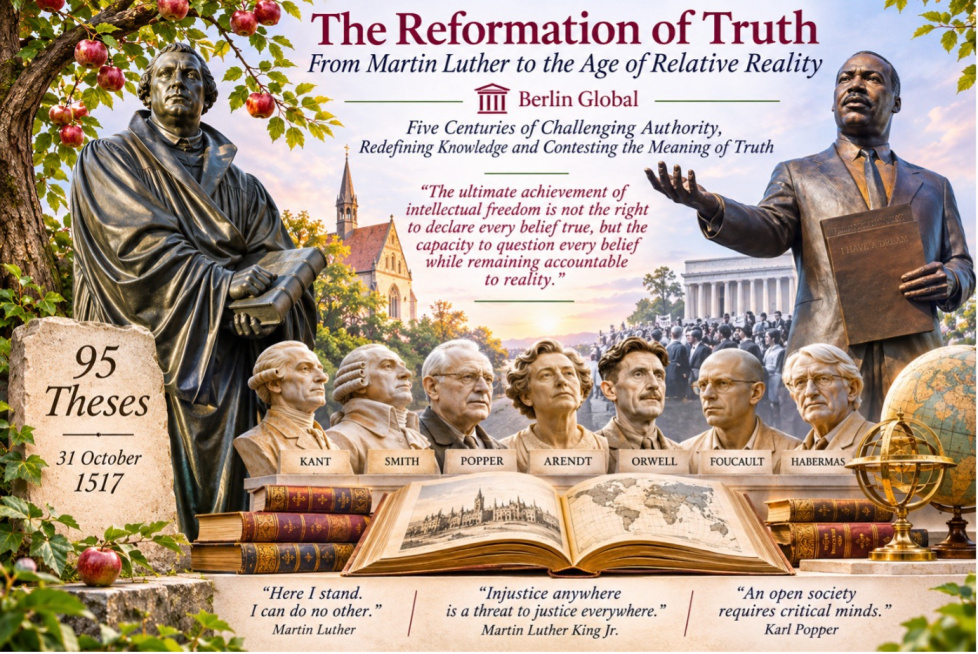
The Historical Paradox of Truth - Today, 509 years ago, On 31 October 1517, Martin Luther initiated a theological controversy that would profoundly transform European civilisation. His Ninety-Five Theses, challenging practices surrounding indulgences, developed into a confrontation over religious authority, individual conscience and the interpretation of Christian doctrine. More than five centuries later, humanity confronts a different but equally fundamental question: what happens when societies can no longer agree upon the methods through which truth should be established?
The historical paradox is remarkable. The Protestant Reformation challenged established authority over the interpretation of religious truth, while the contemporary digital revolution increasingly challenges the institutions and procedures through which factual claims acquire credibility. The printing press enabled competing religious interpretations to circulate across Europe; digital technologies and artificial intelligence now allow political, economic and social narratives to reach global audiences almost instantaneously.
Yet these transformations should not be confused. Luther did not advocate the relativity of truth. On the contrary, he defended what he considered an authoritative religious understanding against established ecclesiastical interpretations. The contemporary crisis concerns something different: the possibility that factual reality itself may become subordinated to political allegiance, collective identity and competing systems of belief.
The central question is therefore no longer simply who possesses the authority to interpret truth, but whether intellectual freedom can survive without commonly recognised standards of evidence.
The Reformation: The Liberation and Fragmentation of Authority
The Reformation fundamentally altered the relationship between religious institutions, political power and the circulation of knowledge. Luther's insistence upon the authority of scripture challenged established ecclesiastical structures, while printed pamphlets and theological writings enabled religious controversies to reach wider audiences.
However, expanding religious communication did not automatically produce tolerance. Protestant and Catholic authorities defended competing theological positions, frequently through institutional coercion and political confrontation. The emergence of different confessional communities contributed to educational and intellectual developments while simultaneously intensifying religious divisions.
The Peace of Augsburg in 1555 and the Peace of Westphalia in 1648 represented important stages in Europe's development of political arrangements for managing confessional differences. Neither settlement established modern religious freedom, but both reflected the necessity of political coexistence amid enduring disagreement.
The historical lesson is significant: the weakening of established authority may expand intellectual possibilities without necessarily creating common standards of understanding. Competing interpretations can encourage independent inquiry, but they can also generate new forms of orthodoxy.
The Enlightenment: From Authority to Critical Reason
The philosophical transformations associated with the Scientific Revolution and Enlightenment developed through intellectual traditions that cannot be attributed to the Reformation alone. Nevertheless, they helped establish new methods for distinguishing justified knowledge from inherited assumptions.
In Discourse on the Method (1637), René Descartes advanced systematic doubt as an instrument of philosophical investigation. John Locke subsequently examined the origins and limitations of knowledge in An Essay Concerning Human Understanding (1689), while David Hume's An Enquiry Concerning Human Understanding (1748) questioned the certainty of causal inference.
Immanuel Kant brought these debates into a broader philosophical framework. In Critique of Pure Reason (1781), he investigated the conditions under which knowledge becomes possible, while his essay An Answer to the Question: What Is Enlightenment? (1784) defended intellectual independence and the public exercise of reason.
These thinkers did not establish a single philosophy of truth. Their disagreements were substantial. Yet their contributions advanced an enduring intellectual principle: claims to knowledge require justification, and neither tradition nor institutional authority should place them beyond criticism.
The lasting importance of modern critical philosophy lies not in guaranteeing certainty, but in developing methods through which errors can be identified and understanding revised.
Adam Smith and The Wealth of Nations: The Search for Economic Truth
The transformation of intellectual authority during the Enlightenment extended beyond philosophy and natural science into the understanding of economic life. In An Inquiry into the Nature and Causes of the Wealth of Nations (1776), the Scottish philosopher and political economist Adam Smith challenged prevailing mercantilist doctrines and examined the foundations of national prosperity through the division of labour, productivity, competition and international trade. His work helped establish political economy as a field of systematic inquiry, in which economic policies could be evaluated through their consequences rather than justified exclusively by inherited doctrines or the interests of established authorities.
Smith's contribution is particularly relevant to contemporary debates about economic truth. Economic growth, inflation, employment, inequality and national prosperity remain subjects of competing political interpretations, even when governments and researchers draw upon the same statistical evidence. Moreover, economic measurements depend upon definitions, methodologies and assumptions that must themselves remain open to examination. Smith's intellectual legacy therefore illustrates both the importance and the limitations of economic reasoning: economic knowledge requires evidence, critical investigation and an understanding of complex social relationships, rather than unquestioning acceptance of political narratives.
Nearly 250 years after the publication of The Wealth of Nations, the distinction between economic evidence and ideological interpretation remains essential to responsible public policy and democratic accountability.
Truth and Power: Orwell, Arendt and Foucault
The twentieth century revealed that the vulnerability of truth was not exclusively a philosophical problem. It could become an instrument of political domination.
George Orwell's Nineteen Eighty-Four (1949) depicted a society in which political authority manipulated historical records and language, undermining independent factual judgement. Aldous Huxley's Brave New World (1932) explored a contrasting danger: social conformity maintained through conditioning, consumption and distraction. Neil Postman subsequently examined the transformation of public discourse into entertainment in Amusing Ourselves to Death (1985).
Hannah Arendt developed a more explicitly political analysis in The Origins of Totalitarianism (1951) and her essay Truth and Politics (1967). She distinguished the legitimate plurality of political opinions from the factual circumstances upon which those opinions depend.
For Arendt, democratic disagreement requires a sufficiently shared factual world within which different interpretations can be debated. When documented circumstances become interchangeable political constructions, the foundations of public judgement are weakened.
Michel Foucault approached the relationship between truth and authority differently. In Discipline and Punish (1975) and the collection Power/Knowledge (1980), he examined how institutions, disciplinary practices and systems of knowledge interact with relations of power.
Their perspectives illuminate complementary concerns. Arendt emphasised the political importance of factual truth, while Foucault investigated the institutional conditions under which knowledge becomes authoritative. Societies must therefore protect factual inquiry while remaining capable of critically examining the structures that influence its production and recognition.
The Limits of Interpretation: Popper, Eco and Habermas
The distinction between critical inquiry and unrestricted relativism becomes clearer through Karl Popper, Umberto Eco and Jürgen Habermas.
In Logik der Forschung (published in 1934 with a 1935 imprint; subsequently published in English as The Logic of Scientific Discovery in 1959), Popper advanced falsifiability as a criterion for empirical scientific theories. His approach emphasised criticism and potential refutation rather than unquestionable certainty. In The Open Society and Its Enemies (1945), he challenged political philosophies claiming privileged knowledge of historical development.
Umberto Eco addressed a related problem in The Limits of Interpretation (1990). While recognising that texts can sustain multiple meanings, Eco challenged the assumption that every interpretation is equally defensible. Intellectual freedom does not eliminate the responsibility to respect evidence and interpretative constraints.
Jürgen Habermas examined the democratic implications of public reasoning in The Structural Transformation of the Public Sphere (1962) and The Theory of Communicative Action (1981). His work explored the conditions under which communication can support rational criticism and mutual understanding rather than merely reproduce relations of power.
Together, these thinkers illuminate three requirements of an intellectually open society: claims must remain open to criticism, interpretations must be subject to reasoned evaluation, and public debate must provide opportunities for arguments to be examined beyond political allegiance.
The Digital Reformation: When Information Becomes Reality
Digital communication has transformed the conditions under which societies encounter and evaluate information. Technological platforms enable individuals and organisations to circulate competing narratives globally, while commercial incentives frequently reward attention, emotional engagement and simplified explanations.
This transformation has expanded access to knowledge and created new opportunities for participation. Yet artificial intelligence introduces additional complexities by enabling increasingly convincing synthetic texts, images and recordings. Its potential benefits for scientific discovery and education coexist with difficulties concerning authenticity and verification.
Jean-François Lyotard's The Postmodern Condition (1979) offers a relevant perspective through its examination of the declining credibility of overarching narratives used to legitimise knowledge. Nevertheless, scepticism towards universal explanations should not be confused with the proposition that factual claims possess no independent basis.
The deeper danger emerges when political conviction determines which evidence individuals are prepared to recognise. Disagreement then ceases to concern the interpretation of shared circumstances and increasingly concerns the existence of those circumstances themselves.
Democracy, Cultural Diplomacy and Shared Knowledge
The consequences extend directly to democratic governance and international relations. Political pluralism depends upon disagreement, but meaningful accountability requires sufficiently reliable information about governmental decisions, economic developments and historical events.
Economic statistics may be interpreted differently, historical evidence may support competing explanations, and diplomatic negotiations may involve fundamentally opposed interests. Such differences are legitimate. They become more difficult to manage when participants no longer recognise common standards of verification.
Cultural diplomacy, historical scholarship, scientific cooperation and educational exchange consequently acquire renewed importance. Their contribution lies not in eliminating intellectual differences, but in creating conditions through which competing perspectives can be examined through evidence, dialogue and mutual understanding.
From Martin Luther to Martin Luther King Jr.: Berlin, the Reformation and the Struggle for Civil Rights
The historical influence of the German Reformation extended far beyond Europe, acquiring an extraordinary transatlantic dimension through the family of the American civil rights leader Martin Luther King Jr. The connection originated with his father, the Baptist minister Michael King Sr., who travelled to Germany in 1934, more than four centuries after Martin Luther had initiated the Protestant Reformation.
Michael King Sr., pastor of Ebenezer Baptist Church in Atlanta, attended the Fifth Baptist World Alliance Congress in Berlin in August 1934. His wider journey also included visits to other European countries and the Middle East. Germany was then under National Socialist rule, and the congress took place against the background of increasing political repression and racial persecution. Significantly, the international Baptist gathering adopted a resolution condemning racial hostility and discrimination, including oppression directed against Jews and people of colour.
The journey became closely associated with Michael King Sr.'s admiration for the sixteenth-century German reformer Martin Luther (1483–1546). Following his European travels, the American minister increasingly adopted the name Martin Luther King Sr. His son, born Michael King Jr. in Atlanta on 15 January 1929, also came to bear the name Martin Luther King Jr. The precise administrative history of these changes was gradual; the son's birth certificate was formally amended in 1957. The name thus established a direct symbolic connection between the German Reformation and the family that would later become internationally associated with the American civil rights movement.
The younger Martin Luther King Jr. (1929–1968), who became a Baptist minister and one of the principal leaders of the American civil rights movement, developed his own philosophy of justice, equality and nonviolent resistance. On 12 April 1963, he was arrested in Birmingham, Alabama, during demonstrations against racial segregation. While imprisoned, he composed his celebrated Letter from Birmingham Jail, dated 16 April 1963, in which he distinguished between just and unjust laws and defended the moral responsibility to challenge institutionalised injustice. It was therefore the son, Martin Luther King Jr., rather than his father, who wrote this influential document.
The historical connection returned to Berlin in September 1964, when Martin Luther King Jr. visited the divided city and delivered addresses in both West and East Berlin. His visit took place at the height of the Cold War, when the Berlin Wall symbolised the political and ideological division of Europe. Speaking across this division, King connected his commitment to human dignity and freedom with the broader moral questions confronting societies separated by political systems and physical barriers.
A further symbolic connection emerged on 10 July 1966, when Martin Luther King Jr. led civil rights demonstrators to Chicago City Hall and attached demands for fair housing to its doors. The action recalled the traditional account of Martin Luther presenting his Ninety-Five Theses at the Castle Church in Wittenberg on 31 October 1517. Although the historical circumstances and objectives of the two reformers differed considerably, the parallel illustrated the continuing symbolic power of publicly challenging established authority through written demands for reform.
The relationship between Martin Luther and Martin Luther King Jr. should not be understood as one of identical theological or political convictions. Luther's central concerns involved Christian doctrine, salvation and ecclesiastical authority, while King's public mission addressed racial equality, constitutional rights and nonviolent social transformation. Nevertheless, their historical association demonstrates how religious ideas and traditions of conscience can acquire new meanings across centuries and continents.
The sequence is remarkable: Martin Luther challenged ecclesiastical authority in Germany in 1517; Michael King Sr. travelled to Berlin in 1934 and subsequently adopted the reformer's name; and his son, Martin Luther King Jr., carried that name into the American civil rights movement, returning to Berlin in 1964 as an internationally recognised advocate of freedom and human dignity.
This historical connection enriches the broader discussion of truth and authority by demonstrating how intellectual and religious legacies can transcend their original contexts, inspiring new generations to examine the moral legitimacy of established institutions.
The Freedom to Question and the Responsibility to Know
The Reformation challenged established religious authority, the Enlightenment advanced methods of critical inquiry, and modern political philosophy examined the relationships between knowledge, interpretation and power. Each transformation expanded possibilities for intellectual independence while exposing new tensions between freedom and authority.
The contemporary digital revolution presents a further historical challenge. Humanity has acquired extraordinary capacities to produce and distribute information, yet these capacities do not automatically strengthen its ability to distinguish reliable knowledge from unsupported assertion.
Five centuries after Luther's challenge to ecclesiastical authority, modern civilisation faces a profound reversal. The historical struggle concerned the freedom to question those claiming authority over truth. The contemporary struggle increasingly concerns preserving the possibility of investigating truth independently of authority.
A society in which every political community possesses its own unquestionable reality may retain the outward institutions of democracy while gradually losing the intellectual foundations necessary for meaningful deliberation.
The ultimate achievement of intellectual freedom is not the right to declare every belief true, but the capacity to question every belief while remaining accountable to reality.
Selected Primary Works and Intellectual References
Martin Luther — Disputation on the Power and Efficacy of Indulgences (Ninety-Five Theses, 1517).
René Descartes — Discourse on the Method (1637).
John Locke — An Essay Concerning Human Understanding (1689).
David Hume — An Enquiry Concerning Human Understanding (1748).
Adam Smith — An Inquiry into the Nature and Causes of the Wealth of Nations (1776).
Immanuel Kant — Critique of Pure Reason (1781); An Answer to the Question: What Is Enlightenment? (1784).
Aldous Huxley — Brave New World (1932).
Karl Popper — Logik der Forschung (1934, 1935 imprint; English edition 1959); The Open Society and Its Enemies (1945).
George Orwell — Nineteen Eighty-Four (1949).
Hannah Arendt — The Origins of Totalitarianism (1951); Truth and Politics (1967).
Martin Luther King Jr. - Letter from Birmingham Jail (1963), and Why We Can't Wait (1964)
Michel Foucault — Discipline and Punish (1975); Power/Knowledge (1980).
Jean-François Lyotard — The Postmodern Condition (1979).
Jürgen Habermas — The Structural Transformation of the Public Sphere (1962); The Theory of Communicative Action (1981).
Neil Postman — Amusing Ourselves to Death (1985).
Umberto Eco — The Limits of Interpretation (1990).
