
The Pragmatic Camp in Israel Must Replace Netanyahu and His Government
Netanyahu Has Lost His Majority, but Can the Leaders of the “Change Bloc” Overcome Their Divisions to End His Rule?
November 02nd, 2026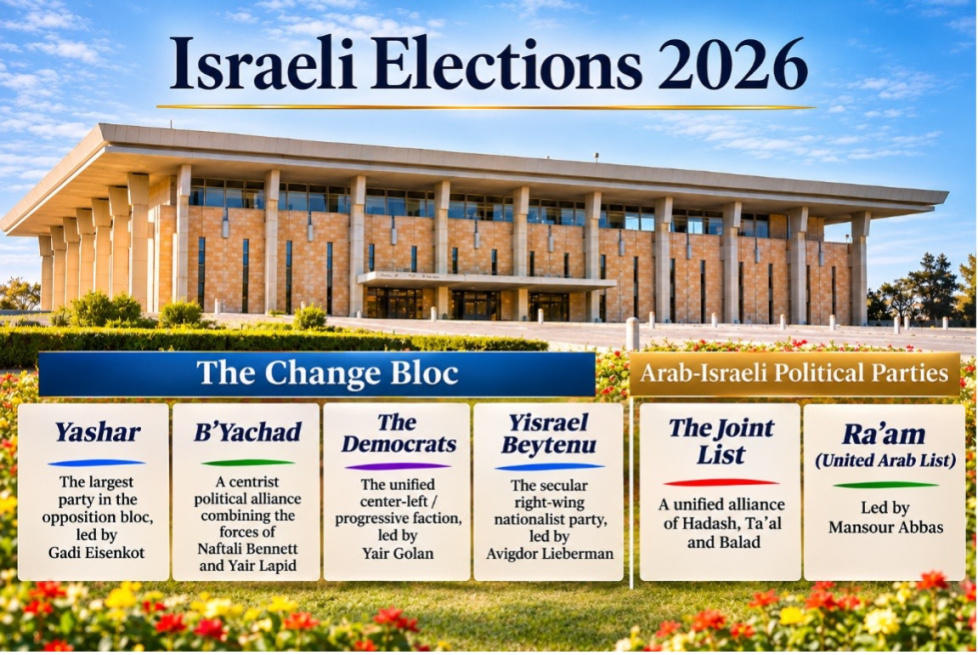
The results of the elections in Israel surprised many on both the right and the left. Likud, Netanyahu's ruling party, won 27 seats (out of 120), while Yashar, the new party headed by Gadi Eisenkot, won only 21 seats. However, the bloc led by Netanyahu secured only 53 seats, while the opposition parties, all of which seek to bring Netanyahu's term in office to an end, hold 67 seats in the Knesset. On the face of it, all that remains is to form a new government headed by Gadi Eisenkot, the former IDF Chief of Staff, which could dramatically change the face of Israel.
However, the four Zionist parties opposed to Netanyahu are divided over whether to cooperate with the other two opposition parties, which together hold 19 Knesset seats and whose members are predominantly Arab (one composed mainly of communists and the other mainly of Islamists). This division calls into question the possibility of forming an alternative government.
One possible outcome is that no new government will be formed, leaving Netanyahu's current government in office as a caretaker government for many months until new elections are held. This would mean that, throughout this period, Israeli policy would remain unchanged regarding the conduct of Jewish terrorists who attack Palestinian residents of the West Bank. There would be no change in policy towards the Palestinian Authority, the funds that Israel has frozen would not be released, and no progress would be made on the two most important plans concerning the Palestinian issue and Israeli-Palestinian reconciliation: Trump's 20-point plan, which became the basis of a UN Security Council resolution, and his 15-point plan for implementing the reconstruction and rehabilitation of the Gaza Strip.
The problem is that the four Zionist parties comprising the camp seeking to oust Netanyahu (with the exception of the Democrats) competed against one another in the run-up to the elections, setting various conditions for their future coalition partners: not including the Arab parties in the next government, not including the ultra-Orthodox religious parties, not participating in a government headed by Netanyahu, and others. Now, following the elections, these parties face an unsurprising dilemma: either form an alternative government to the right-wing coalition by abandoning some of their electoral promises, or honour those promises and drag Israel into another round of elections in 2027, much to the disappointment of their own voters.
If the latter course is taken, Israel will find itself with Netanyahu remaining as prime minister, despite an arrest warrant issued by the International Criminal Court that prevents him from visiting most countries. He would continue to sit in the most sensitive government meetings alongside figures who emerged from the fringes of politics, despite having promised only a few years ago that he would never appoint them as ministers. Beyond his responsibility for the horrific massacre of October 7, 2023, he also bears responsibility for Israel having become almost a pariah state, and for Jews around the world paying a price for being Jewish that they have not paid in the past. In the eyes of those who hate them, they are automatically regarded as supporters of Israel, whether they wish to be or not.
The end of Netanyahu's term in office is essential to restoring Israel's policies and international standing, and the October 27 elections have made this a realistic possibility. This is the responsibility of Israelis who are concerned not only about the fate of Israel's residents but also about the fate of Palestinians who wish to live alongside them in peace, and who are all portrayed by the Israeli right as supporters of terrorism. If the pragmatic camp in Israel abandons the opportunity to form a government in which no one who served in the government on October 27 would hold office, and in which Arab politicians would participate as genuine partners in determining their own future and that of the country, it would be irresponsible. Truly irresponsible.
