
“Plus ça change, plus c’est la même chose”
The Machinery of the World Has Changed Beyond Recognition, but the Motives Driving It Have Not, Making Dialogue and Diplomacy as Crucially Necessary as Ever
September 27th, 2026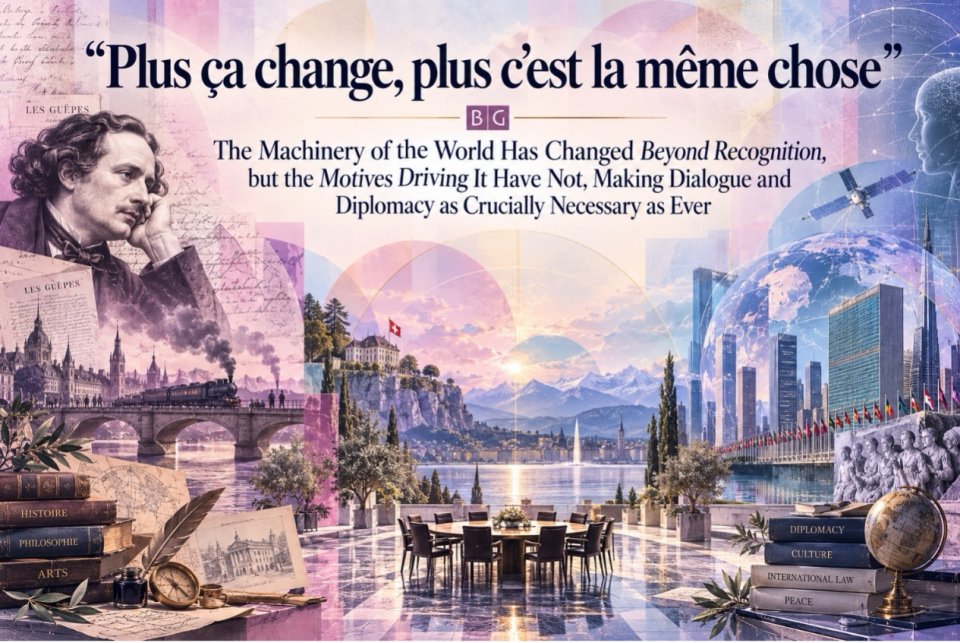
In January 1849, the French writer and journalist Alphonse Karr published the epigram that would become his most enduring contribution to political language: “Plus ça change, plus c’est la même chose.” The more things change, the more they remain the same.
It appeared at an extraordinary historical moment. Europe had just experienced the revolutions of 1848, a wave of upheaval stretching from France and the German states to the Habsburg lands and the Italian peninsula. Monarchies had been challenged, constitutions demanded, national aspirations mobilised and established political orders shaken. To contemporaries, it could appear that an old Europe was disappearing and another was struggling to be born.
Karr's aphorism captured the scepticism that often follows such moments of apparent transformation. Governments fall, institutions change, technologies advance and political vocabularies are reinvented, yet some of the forces beneath political life prove remarkably persistent.
Almost 180 years later, this tension between transformation and continuity has acquired a new significance.
The world of 2026 would be virtually incomprehensible to Karr. Human beings cross continents in hours and communicate across them instantaneously. Satellites connect societies and observe the planet from space. Nuclear weapons have transformed the possible scale of warfare. Artificial intelligence is changing the production and transmission of knowledge. Economies separated by oceans depend upon intricate networks of finance, trade, energy and technology. International organisations bring together states that, in Karr's time, possessed few permanent mechanisms through which to address common problems.
The machinery of the world has changed beyond recognition. The motives driving it often have not.
New World, Old Motives
Strip international relations of their contemporary terminology and many of their central questions are ancient ones. Who controls territory? Where should borders lie? How much power should one state possess? How can a country protect itself without making its neighbour feel less secure? When should sovereignty prevail, and when should states accept international restraint? How are resources, influence and responsibility to be distributed?
Behind such questions lie forces even older than the modern state: fear, ambition, pride, insecurity, humiliation, identity, mistrust, competition, the desire for recognition and the instinct for self-preservation.
This does not mean that history simply repeats itself. Historical analogies can illuminate, but they can also mislead. The Europe of 1848, the Europe of 1914 and the international system of 2026 are profoundly different. The actors, institutions, technologies, economic relationships and legal frameworks are different. To claim that contemporary conflicts are merely repetitions of earlier ones would obscure precisely those differences that historians and diplomats must understand.
The more interesting continuity lies not in events but in behaviour. States still calculate interests. Governments still fear vulnerability. Societies still carry memories of past injuries. Political leaders still respond to prestige, domestic pressures and perceptions of strength and weakness. Nations still seek security, recognition and influence.
This produces one of the central paradoxes of modern civilisation: humanity has become extraordinarily successful at changing the world, but considerably less successful at changing itself.
The Paradox of Progress
This paradox matters because technological progress does not simply coexist with enduring human impulses. It magnifies their consequences.
Fear armed with a sword is not the same as fear armed with nuclear weapons. Propaganda carried slowly between communities is not equivalent to disinformation capable of reaching millions of people almost instantaneously. Economic rivalry between neighbouring states acquires a different significance when production, energy, financial markets and supply chains connect societies across continents.
Our instruments become more sophisticated while many of the emotions governing their use remain recognisably human.
We should therefore be cautious about confusing technological advancement with political or moral progress. A society can possess remarkable scientific capabilities and remain deeply divided. A state can become wealthier and more powerful without becoming more willing to compromise. Faster communication can promote understanding, but it can also accelerate anger, misinformation and polarisation. Artificial intelligence may increasingly overcome linguistic barriers, but no machine can guarantee that two societies will interpret the same history, symbol or political act in the same way.
The challenge of progress, therefore, is not simply whether humanity can continue expanding what it is capable of doing. It is whether our political wisdom and capacity for cooperation can keep pace with our increasing power to affect one another.
That is what gives Karr's nineteenth-century observation its particular relevance today. Persistent human motives become more consequential, not less, when the instruments available to them become vastly more powerful.
If Human Nature Persists, Does Progress Exist?
Taken too literally, Plus ça change, plus c'est la même chose can become an argument for fatalism. If human behaviour remains essentially unchanged, perhaps history is merely an endless cycle in which optimism is repeatedly defeated by the same ambitions and conflicts.
The historical record suggests something more complicated.
The political and moral universe has changed substantially since Karr's lifetime. Slavery, once legally embedded in many societies, has been abolished as a lawful institution across the world. Colonial empires have disappeared. Political participation has expanded. International human-rights law has developed. The principle that states should be constrained in their use of force has been incorporated into an international legal order.
Europe provides one of the clearest demonstrations that inherited patterns of rivalry need not determine the future. France and Germany fought three wars between 1870 and 1945. After the devastation of the Second World War, political leaders deliberately sought to replace recurrent rivalry with institutionalised cooperation.
Robert Schuman's declaration of 9 May 1950 proposed placing French and West German coal and steel production under a common authority. The resulting European Coal and Steel Community, established by six countries, became the first in the succession of supranational institutions from which today's European Union developed. The purpose was explicitly political as well as economic: the pooling of industries essential to warfare was intended to make another war between France and Germany not merely difficult to imagine, but materially harder to wage. European Union
The significance of this history extends beyond Europe. It demonstrates that reconciliation does not require the disappearance of national identity, interests or historical memory. What can change are the structures through which those forces interact.
This suggests a more useful definition of civilisation: civilisation is not the disappearance of humanity's ancient instincts, but the development of institutions, norms and relationships capable of restraining their most destructive consequences.
1945: Institutionalising the Lessons of Catastrophe
Few generations confronted the destructive potential of modern civilisation more directly than the generation of 1945.
The response to the Second World War was not founded on the assumption that human beings had suddenly ceased to be ambitious, fearful or competitive. It reflected recognition of precisely the opposite problem: modern technology and organised state power had made the consequences of political failure catastrophically greater.
The creation of the United Nations was one response. Representatives of 50 countries met in San Francisco in 1945 to draft the Charter; with Poland joining the original signatories subsequently, the organisation began with 51 member states. The Charter was signed on 26 June, and the United Nations formally came into existence on 24 October 1945. Its creation reflected the determination to construct an international framework capable of helping prevent another world war. United Nations
The United Nations has not eliminated war, nor does it stand outside international politics. Its structure itself reflects political realities and power disparities, most obviously in the Security Council.
Yet to judge international institutions only by the conflicts they fail to prevent is to misunderstand their purpose. Diplomacy does not abolish disagreement. International institutions do not eliminate national interest. Law does not make power disappear. Their value lies in creating mechanisms through which competing interests can be expressed, contested, negotiated and, sometimes, reconciled without violence.
A negotiating table cannot guarantee agreement. Its first achievement is more modest but fundamental: it gives disagreement somewhere to go other than the battlefield.
Why Diplomacy Exists
This brings us to the central lesson of Karr's epigram.
Diplomacy is sometimes presented as though it rests upon the optimistic assumption that reasonable people, given sufficient opportunity, will eventually agree. Its historical necessity rests on almost the opposite premise.
We need diplomacy because people do not naturally agree. We need international institutions because states have conflicting interests. We need international law because power alone cannot provide a stable basis for relations among states. We need negotiation because governments interpret security, justice, history and responsibility differently.
The persistence of disagreement is not evidence that diplomacy has failed. It is the reason diplomacy exists.
But diplomacy cannot remain static while the instruments of power evolve around it. The extraordinary investment devoted to military capability, technological competition, economic security and strategic influence should be accompanied by serious investment in the instruments that prevent those forms of power from producing conflict. Mediation, preventive diplomacy, discreet back channels, protecting-power arrangements and trusted places for negotiation are not remnants of an older diplomatic world. They are part of the infrastructure required by the new one.
Switzerland offers perhaps the clearest example. Its tradition of good offices includes mediation, hosting negotiations and acting as a protecting power when states have broken diplomatic relations. In the latter role, Switzerland can preserve a minimum channel of communication between governments that are no longer speaking directly. As of February 2026, it held eight such mandates. Geneva's concentration of diplomatic missions and international institutions further strengthens its role as a place where adversaries can meet. Federal Department of Foreign Affairs Norway represents a different model, emphasising peace facilitation, dialogue with relevant parties and the preservation of channels through which political solutions can be explored. Regjeringen.no
These examples point towards something the international system should consciously preserve and develop: diplomatic safe havens. The world needs countries, cities and institutions that opposing sides regard as sufficiently credible to exchange messages, conduct exploratory discussions and search for compromise. No country is without interests, and neutrality should never be confused with indifference. What matters is the existence of trusted diplomatic space in which communication can continue when ordinary political relationships have failed.
We routinely think of roads, ports, communications networks and energy systems as infrastructure. International society also requires infrastructure for disagreement. It needs trusted venues, credible intermediaries, institutional memory, personal relationships and channels that remain available precisely when relations deteriorate.
Diplomacy should therefore not be measured only by treaties signed or summits concluded. Much of its value is preventive and consequently invisible. A crisis that does not become a war leaves no battlefield. A misunderstanding corrected privately produces no monument. A relationship preserved during political disagreement rarely attracts the attention generated by its collapse.
Yet these quieter achievements constitute part of the architecture of international stability.
From Diplomacy to Cultural Diplomacy
Formal diplomacy, however, reaches only part of the problem.
Conflicts between societies are not always disagreements about territory, resources or strategic interests. They may also concern memory, identity, religion, historical experience, dignity and fundamentally different understandings of justice. Governments can negotiate interests; it is considerably more difficult to negotiate collective memory.
This is where cultural diplomacy becomes part of the same architecture.
Traditional diplomacy frequently begins by asking what governments can agree upon. Cultural diplomacy can begin with another question: why do we see the same thing differently?
Understanding another society does not require agreeing with it. Dialogue does not require the abandonment of principle. Compromise does not require pretending that profound differences do not exist. The objective is more fundamental: to prevent difference from automatically becoming hostility.
This idea was embedded in the post-war international order from its beginning. UNESCO's Constitution argued that peace based only upon political and economic arrangements among governments would be insufficient, and that lasting peace also required what it called the “intellectual and moral solidarity of mankind.” UNESCO It was an important recognition that peace is not constructed exclusively in ministries and conference rooms. It must also exist in the relationships between peoples.
That insight has become more relevant, not less, in the digital age. More communication does not necessarily produce more understanding. Two societies can receive the same information instantly and interpret it through entirely different histories. Technology can increasingly translate vocabulary; it cannot automatically translate memory.
Cultural diplomacy operates in this difficult space between communication and understanding. Encounters among academics, artists, students, religious figures, civil society, business leaders, former political leaders and diplomats can maintain relationships beyond the immediate political dispute. They cannot substitute for security policy or formal negotiations, nor should they be expected to. Their value is different: they preserve human contact when political narratives threaten to reduce entire societies to adversaries.
The More Things Change
Karr's epigram therefore deserves to be read not as an expression of resignation, but as a warning against complacency.
The world does change. Institutions matter. Laws matter. Political choices matter. The transformation of Franco-German relations demonstrates that patterns of hostility once regarded as almost permanent can be altered through deliberate political construction. The United Nations demonstrates the continuing attempt to provide a common arena for states whose interests frequently collide. Switzerland's good offices demonstrate the importance of preserving communication even when ordinary diplomatic relations break down.
What does not change so readily are many of the human impulses with which these institutions must contend.
And this is precisely why the distinction matters. If human nature could be perfected, diplomacy might eventually become unnecessary. If national interests disappeared, international institutions would have little purpose. If cultural difference automatically produced mutual understanding, cultural diplomacy would be redundant.
Reality is otherwise.
The task is not to wait for humanity to become something fundamentally different. It is to continue improving the political, legal, diplomatic and cultural mechanisms through which imperfect human beings and imperfect states can coexist.
This is perhaps the deeper message hidden inside Plus ça change, plus c'est la même chose. The persistence of old motives should not lead us to conclude that progress is impossible. It should remind us that progress is neither automatic nor irreversible.
Peace cannot simply be achieved once and then inherited intact. Trust requires renewal. Institutions require adaptation. Relationships require cultivation. Diplomacy requires innovation. And dialogue becomes most important precisely when it becomes most difficult.
Nearly 180 years after Karr wrote his famous sentence, humanity possesses powers he could scarcely have imagined. Our ability to communicate, create, travel, produce and destroy has expanded enormously. That makes the ancient weaknesses of human nature more consequential than they were in his time. It also makes the institutions and relationships created to manage them more important.
We do not have to wait for human nature to change before learning how to live together. The enduring task of civilisation is to ensure that our capacity for dialogue develops faster than our capacity for conflict.
