
More Than Cars: Mercedes-Benz Builds Cultural Bridges Across Europe
How Porsche Uses Culture to Connect Communities Across Borders
October 20th, 2026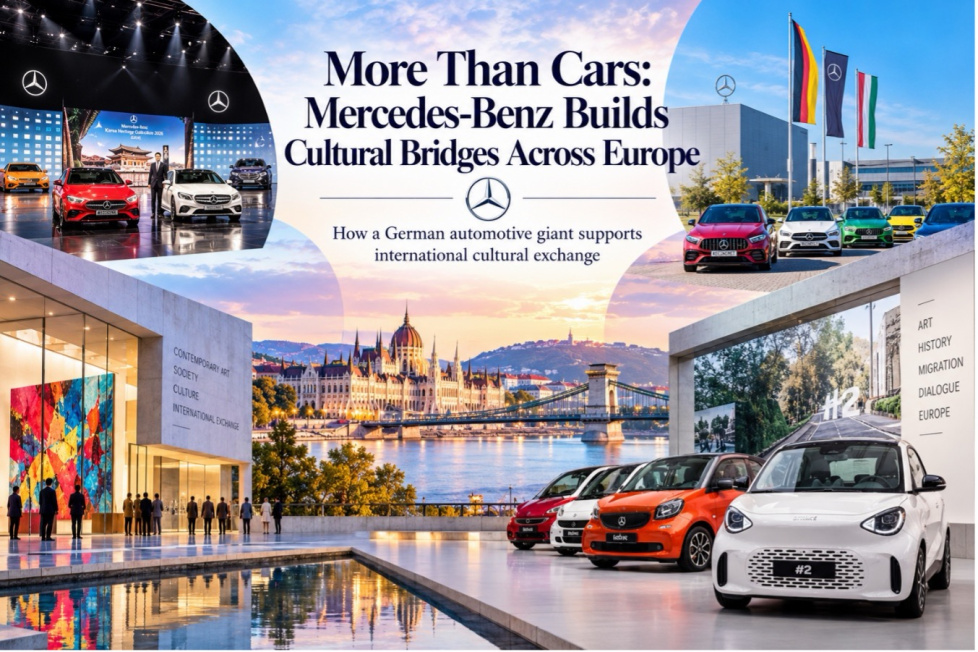
In 2026, Mercedes-Benz extended its international presence beyond the automotive industry through cultural initiatives connecting Germany with artistic communities across Europe and beyond. From exhibitions exploring industrial history and migration to programmes supporting emerging artists, cultural education and international opera, the German manufacturer supported projects that brought together artists, cultural institutions and audiences from different backgrounds. These activities demonstrate how corporate engagement in the arts can contribute to cultural exchange, social dialogue and Germany's cultural presence abroad.
The company's cultural activities took different forms throughout the year. In Budapest, an international exhibition connected industrial development with Central and Eastern European experiences, while a Stuttgart project examined the history of Turkish-German migration. In Berlin, contemporary artists explored new approaches to visual expression, and in Austria, Mercedes-Benz continued its partnership with a major European performing arts festival. Meanwhile, an exhibition in Tokyo introduced Japanese audiences to artworks connecting German automotive history with American pop art. Together, these five initiatives illustrate the different ways in which cultural programmes supported by German businesses can contribute to international cultural relations.
German and Hungarian Artistic Perspectives Meet in Budapest
The Mercedes-Benz Art Collection brought together international contemporary art and Central and Eastern European perspectives through POWER LINES, an exhibition held at the Merlin Cultural Square in Budapest from 28 May to 30 August 2026. Organised as part of the collection's international exhibition programme, the project explored the relationship between industrial development, infrastructure, labour and society through the work of more than 30 artists.
Curated by Krisztián Gábor Török in cooperation with the project management partner Art is Business, the exhibition featured works by internationally recognised figures, including David Hockney, Sylvie Fleury and Robert Longo, alongside Hungarian and regional artists such as Ilona Németh, Rita Süveges and Katalin Kortmann-Járay. The former transformer station housing the exhibition provided a setting closely connected to its themes of energy, production and technological transformation.
Rather than presenting industrial history solely as technological progress, the exhibition examined its consequences for communities and everyday life. Artistic contributions addressed labour migration, working conditions, energy infrastructure and the changing landscapes of Central and Eastern Europe. The public programme also offered guided tours, educational activities, university collaborations and events involving artists from Budapest's Örkény Theatre.
The project's international dimension came from placing artistic interpretations of shared economic and social transformations into dialogue. By connecting works from a German corporate collection with perspectives originating in Hungary and neighbouring countries, POWER LINES created opportunities for audiences to consider how industrialisation has shaped different European societies.
Its contribution to cultural diplomacy therefore extended beyond the international presentation of artworks. Through cooperation with local cultural organisations and educational institutions, Mercedes-Benz supported a platform where regional histories and international artistic perspectives could be examined together, strengthening cultural connections between Germany and Central and Eastern Europe.
VOLLGEPACKT Explores German-Turkish Migration Through Art
Questions of migration, belonging and cultural identity formed the centre of another Mercedes-Benz initiative in Stuttgart. From 10 July to 1 August 2026, the Mercedes-Benz Art Collection presented VOLLGEPACKT at the Projektraum Kunstverein Wagenhalle, using photography, music, literature and public discussions to examine the experiences of Turkish-German families across generations.
The exhibition was based on Başardık, a photographic series by Alwin Maigler commissioned for the Mercedes-Benz Art Collection in collaboration with the company's Turkish Employee Network. The project documented encounters along the historical journey between Germany and Turkey taken by generations of migrant workers and their families. Photographs were presented alongside video interviews and poetic contributions by Merve Kayıkçı, bringing personal memories and family histories into the exhibition space.
An extensive public programme widened the discussion beyond photography. A concert on 10 July featured several musical acts, while a collaboration with Staatsoper Stuttgart on 12 July connected Maigler's work with the opera Station Paradiso, which similarly addresses migration and the meaning of home. Further discussions brought together researchers, cultural practitioners and people with personal connections to migration histories.
The programme also included a lecture examining the experiences of Greek women migrant workers, a reading by Turkish Employee Network founder Nejdet Niflioglu and guided tours exploring different artistic interpretations of identity and belonging.
The exhibition's cultural significance lay in its treatment of migration as part of Germany's shared social history rather than an experience belonging exclusively to one community. By involving employees, artists, educational institutions and cultural organisations, Mercedes-Benz helped create a public space for conversations across generations and cultural backgrounds.
Although the project primarily addressed intercultural relations within Germany, its connection to Turkish-German migration gave it a clear transnational dimension. VOLLGEPACKT demonstrated how artistic collaboration can support mutual understanding and contribute to the recognition of cultural diversity within European societies.
SaDe Opens New Opportunities for Young Artists
Mercedes-Benz Türk continued its longstanding cooperation with the Istanbul Foundation for Culture and Arts (İKSV) through the SaDe Artist Support Fund, a programme designed to support emerging visual artists and strengthen artistic production in Turkey. Established in 2022, the initiative entered its third cycle in 2026, providing financial assistance, professional mentorship and opportunities for artists to develop their projects within the country's cultural sector.
The programme's 2026 participants were announced on 12 May following an open application process that attracted 66 candidates. A five-member selection committee chose Mekin Avras, Baran Aykutbay, Özlem Köse, Hüseyin Turan and Hatice Yıldız Züreyk. Each artist received €5,000 to support their creative work, alongside guidance from experienced professionals in contemporary art, curatorial practice and cultural production.
Beyond financial assistance, SaDe focuses on creating relationships between emerging artists and established cultural practitioners. In October, İKSV confirmed that the five participants were continuing to develop their projects with individual mentors, including curators, artists and cultural researchers. The supported artistic practices explore different social, historical and personal experiences through contemporary visual expression.
The initiative forms part of a wider relationship between Mercedes-Benz Türk and İKSV that has developed over nearly four decades. By working with one of Turkey's major cultural institutions, the German automotive company supports artistic development through a locally established organisation rather than limiting its involvement to individual cultural events.
Although SaDe primarily supports artists working in Turkey and does not constitute a formal bilateral exchange programme, its significance for cultural diplomacy lies in this sustained institutional relationship. The cooperation connects a German industrial group with Turkey's cultural sector, supports artistic diversity and demonstrates how long-term business partnerships can contribute to cultural development and understanding across national boundaries.
The Bregenz Festival Connects International Audiences Through Opera in Austria
Beyond contemporary visual art, Mercedes-Benz continued its involvement in European performing arts through its partnership with the Bregenz Festival in Austria. Held from 22 July to 23 August 2026 on the shores of Lake Constance, the festival brought opera and musical theatre to an international audience, with Giuseppe Verdi's La Traviata presented on the festival's renowned floating stage.
Mercedes-Benz Austria continued as a principal sponsor and exclusive mobility partner of the festival, extending a partnership established in 2024. Under the arrangement, the company provided an electrified fleet of six vehicles to support the festival's operations, linking its mobility activities with the organisation of a major cultural event.
The cooperation demonstrated a practical form of support for the performing arts. Through its contribution to the festival's operational requirements, Mercedes-Benz participated in the wider network of organisations helping sustain an event that attracts audiences and artistic professionals from different countries.
The Bregenz Festival has particular relevance for European cultural cooperation because of its location near the borders of Austria, Germany and Switzerland. Its programme draws on a shared European operatic tradition while bringing international visitors and performers into a common cultural setting.
For Mercedes-Benz, participation in the festival connected a German industrial brand with an Austrian cultural institution and the wider European performing arts community. This relationship illustrates how cross-border corporate partnerships can contribute to the infrastructure supporting international cultural experiences.
The initiative is best understood as cultural sponsorship with an international dimension rather than direct cultural diplomacy. Nevertheless, by supporting an established European festival, Mercedes-Benz contributed to the conditions through which artistic traditions remain accessible to audiences from different societies. The partnership also demonstrated how cooperation between business and cultural institutions can help maintain connections across Europe's national and cultural borders.
Kulturkessel Connects Young People and Cultural Institutions in Stuttgart
Mercedes-Benz also expanded its contribution to cultural participation in Germany through Kulturkessel – Gemeinsam. Kultur. Unternehmen, a five-year funding initiative developed in cooperation with the Kulturkreis der deutschen Wirtschaft. The programme provides €6.5 million to support artistic projects in Stuttgart, encouraging collaboration between independent cultural practitioners and established institutions while creating new opportunities for younger audiences.
Launched in February 2025 and continuing throughout 2026, Kulturkessel supports 21 projects selected from more than 90 applications. The initiative focuses particularly on people aged 15 to 29, seeking to make cultural activities more accessible and encourage their active participation in artistic production. The supported projects cover theatre, music, dance, literature, film, exhibitions and interdisciplinary formats combining creativity with digital technologies.
One of the programme's central principles is cooperation between institutions with established cultural facilities and independent artists or organisations. This approach allows participants to exchange professional experience, experiment with new artistic formats and reach audiences who may have limited access to traditional cultural institutions.
The programme includes Heimat im Dialog – Junge Perspektiven, which encourages young people to explore different understandings of home and belonging through a participatory exhibition. Another supported project, the International U30 Shortmood Film Festival, provides a platform for young filmmakers and international cinematic perspectives. These activities connect cultural education with questions of identity, representation and social diversity.
Kulturkessel's contribution to cultural diplomacy is primarily indirect, as its main geographical focus remains Stuttgart. Nevertheless, projects addressing cultural identity, international filmmaking and community participation can create opportunities for intercultural dialogue within an increasingly diverse European society. By supporting long-term cooperation rather than individual events, Mercedes-Benz demonstrates how corporate cultural engagement can help strengthen the social foundations of international understanding.
Mercedes-Benz and the Cultural Role of Germany's Automotive Industry
The five initiatives undertaken or continued in 2026 demonstrate that Mercedes-Benz's activities extend beyond manufacturing and commercial partnerships. Through international exhibitions, artistic development programmes, cultural education and support for the performing arts, the company engaged with questions of migration, identity, industrial history, artistic innovation and shared European heritage.
Their diplomatic significance, however, varies according to the nature of each project. POWER LINES and VOLLGEPACKT created opportunities for intercultural dialogue through artistic collaboration and public participation, while the SaDe Artist Support Fund demonstrated the value of sustained cooperation with a major Turkish cultural institution. The partnership with the Bregenz Festival supported an established platform for European performing arts, whereas Kulturkessel focused on widening cultural participation and strengthening cooperation among artistic communities within Germany.
Together, these examples illustrate how the German automotive industry can contribute to cultural relations by providing resources, artistic platforms and opportunities for cooperation. While corporate initiatives do not replace the work of diplomatic missions or cultural institutes, they can complement broader efforts to connect societies through art and shared cultural experiences. In this way, Mercedes-Benz's cultural activities in 2026 demonstrate how long-term institutional partnerships and contemporary artistic engagement can contribute to Germany's international cultural presence.
References:
- https://group.mercedes-benz.com/sustainability/society-governance/corporate-social-responsibility/engagement-in-stuttgart.html
- https://media.mercedes-benz.at/news-eine-buehne-fuer-kultur-und-mobilitaet-mercedes-benz-oesterreich-verlaengert-engagement-bei-den-bregenzer-festspielen?id=226056&imageid=905225&l=deutsch&menueid=9661
- https://www.iksv.org/tr/haber/sade-sanatci-destek-fonu-programi-2026-donemi-sanatcilari-belirlendi
- https://www.mercedes-benz.art/en/vollgepackt/
- https://media.mercedes-benz.com/en/article/181da217-0caf-40c4-b682-777728dcfcdc
