
Humanity Has Finally Created the Ultimate “Perpetuum Mobile”
How the digital era created a monstrous machine that feeds on division and confrontation
September 25th, 2026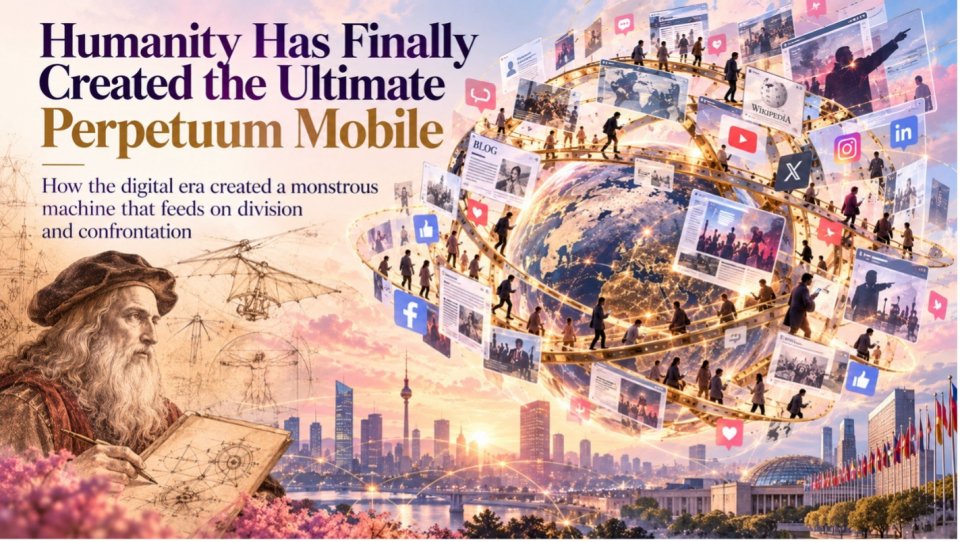
When Publication Was Difficult - There was a time, not very long ago, when reaching the public was difficult. In democratic societies, freedom of expression protected the right to hold opinions, criticise governments and participate in public debate, but freedom to speak was not the same as possessing the means to publish. To address thousands or millions of people usually required access to a newspaper, publishing house, radio station, television network or established institution.
That system was far from perfect. Editors could be biased, publishers could exclude unconventional voices, media ownership could concentrate influence and minorities could struggle to enter public debate. The old gatekeepers did not guarantee truth or fairness. Yet the system contained something whose importance became clearer only after much of it disappeared: friction.
Publication required money, infrastructure and professional intermediaries. Newspapers had editors and lawyers, publishers had reputations to protect and broadcasters were identifiable institutions. An accusation intended for mass circulation might therefore encounter basic questions before publication. Could it be substantiated? Was it defamatory? Who would take responsibility for publishing it? Defamation, propaganda and character assassination certainly existed long before the internet. What was different was the difficulty of distributing them instantly, repeatedly and globally without access to the machinery of mass communication.
The Gatekeepers Disappear
The internet dismantled much of this architecture within a remarkably short period. Personal websites and discussion forums were followed by blogs, collaborative platforms, online rating systems and social networks. Wikipedia was founded in 2001, WordPress appeared in 2003 and Facebook followed in 2004. These platforms were very different from one another, and Wikipedia in particular developed an extensive collaborative editorial structure, but together they reflected a larger historical transformation: the production and distribution of public information were no longer confined to traditional institutions.
This was one of the great democratisations of communication in human history. Citizens could document abuses, dissidents could circumvent censorship, communities could organise, businesses could communicate directly with customers, social movements could mobilise without established intermediaries and people previously excluded from traditional media could finally speak for themselves. Eventually, the smartphone placed a printing press, camera, recording studio and international distribution system into a single pocket.
Humanity gained an extraordinary new freedom. At the same time, it removed much of the friction that had previously stood between a private thought and mass publication.
Everyone Becomes a Publisher
The transformation was therefore more profound than simply giving everyone a voice. Human beings have always had voices. What changed was that almost everyone acquired the potential to become a publisher.
An angry customer could address thousands of people before a company even knew there was a complaint. A private disagreement could become a public spectacle. A photograph could be distributed without context. A rumour could cross national borders before anyone had established whether it was true. An accusation could require seconds to publish while establishing its truth might require weeks, months or a court proceeding.
The law did not disappear, and defamation did not become legal. Courts remain essential, while harsh criticism must not automatically be confused with defamation. Democracies depend upon the ability to criticise governments, companies, institutions and public figures. Yet a profound asymmetry has developed. Law operates through evidence, procedure, jurisdiction and time, while digital networks can distribute information almost instantaneously. The Council of Europe has recognised this problem, noting that content published online in one state can become accessible immediately across the world, creating potentially enormous impact and complicated questions of liability and jurisdiction. It simultaneously warns that excessive defamation restrictions can chill legitimate public debate.
The Birth of the Perpetuum Mobile
For centuries, inventors dreamed of constructing the perpetuum mobile, a machine which, once set in motion, would continue moving indefinitely without requiring an external source of energy. They experimented with wheels, weights, liquids, magnets and ingenious mechanical arrangements, but the laws of physics ultimately defeated the dream. A true perpetual-motion machine is impossible because it would violate the fundamental laws of thermodynamics.
Humanity never succeeded in building one mechanically.
But the digital era may have created its social equivalent.
The mechanism is remarkably simple. Someone makes an accusation and the accused responds. Supporters defend each side, opponents join the discussion, counter-accusations appear, screenshots circulate, old material is rediscovered and audiences divide. The controversy migrates between platforms and communities, while every attempt to answer it can provide new material with which to continue it.
At a certain point something fundamental changes: conflict no longer merely travels through the machine. Conflict becomes part of the energy that keeps the machine moving.
The system does not create energy from nothing. Its energy comes from us, from anger, fear, humiliation, rivalry, resentment, loyalty and the instinct to defend ourselves and those with whom we identify. The “perpetuum mobile” is therefore not a technological machine in the literal sense, but a feedback system in which human confrontation can continuously generate the conditions for further confrontation.
When Conflict Becomes Valuable
The development of engagement-based digital systems added another dimension. Human attention became measurable through clicks, comments, shares, viewing time and other forms of interaction. Platforms could use such signals when determining which material should receive further exposure.
This does not mean that algorithms created human hostility or that social media alone causes political polarisation. Political division has historical, economic, cultural and ideological causes that long predate the internet. The stronger academic argument is more precise: the architecture through which information reaches people can influence which forms of communication receive attention.
A 2026 study published in Nature, based on 2,000 participants randomly assigned to different feed-ranking systems over eight weeks around the 2024 US presidential election, found that engagement-based feeds amplified intergroup, moralised, emotional and toxic content compared with reverse-chronological feeds, with particularly strong increases in moral outrage and political content. The study also found increased perceptions of partisan animosity, although it did not find significant changes in participants' own engagement behaviour.
This distinction is important. Technology did not invent confrontation. It created an environment in which confrontation can acquire informational and economic value because confrontation attracts attention.
Humans produce conflict. Conflict produces attention. Attention produces engagement. Engagement can produce visibility. Visibility creates the opportunity for further conflict.
The wheel turns again.
From Families to Geopolitics
What makes this mechanism historically remarkable is its reach. The same broad communications infrastructure extends from intimate human relationships to international politics. Families quarrel through messaging groups, friendships fracture publicly, neighbours conduct disputes before audiences, businesses face reputational campaigns, competitors fight over public perception, communities divide around local controversies and political parties attack their opponents while factions within those parties employ similar instruments against one another.
Most digital communication is not destructive. Online networks have created extraordinary possibilities for knowledge, friendship, cultural exchange, solidarity and cooperation. The problem is not that everything online has become hostile. The problem is that humanity has never before possessed an infrastructure capable of carrying interpersonal, commercial, social, political and international confrontation simultaneously, continuously and globally.
At one end of the spectrum stands the school pupil who discovers that humiliation no longer ends when the school day finishes because the audience follows the child home. At the other stand governments possessing the resources to conduct sophisticated information operations across national borders. Their purposes and consequences are vastly different, but they increasingly inhabit overlapping information environments. Governments, political organisations, companies, activists, communities, competitors and private citizens compete for attention within the same broad ecosystem of posts, videos, messages, ratings, images and narratives.
The distance between the schoolyard and geopolitics has, in this particular sense, become remarkably small.
When Confrontation Becomes a Profession
An even more consequential development occurs when confrontation ceases to be entirely spontaneous and becomes professionalised. There are legitimate professions devoted to political communication, advocacy, public relations, campaigning and reputation management, and these should not be confused with manipulation. Alongside them, however, substantial evidence documents organised operations designed to distort public discussion, manufacture apparent support, attack opponents or disguise coordinated intervention as spontaneous public opinion.
Freedom House reported that during the period covered by its 2023 Freedom on the Net study, at least 47 countries featured pro-government commentators using covert or deceptive tactics to manipulate online information. It also identified an emerging market of commercial services supporting state-backed content manipulation.
This changes the character of the public sphere. A citizen looking at thousands of apparently independent comments may have no reliable way of determining whether they represent thousands of independent opinions, organised activism, paid intervention, automated amplification or some combination of them.
The appearance of public opinion can itself become a product.
Division can therefore acquire political and commercial utility. Attention can be monetised, reputations can be defended or attacked, narratives can be promoted and existing tensions can be deliberately intensified. The machine is no longer fed only by people who genuinely dislike one another. It can also be fed by actors who benefit from persuading other people to dislike one another.
The Algorithm Joins the Machine
The first internet revolution democratised publication. The next transformed distribution. Once billions of pieces of content competed for finite human attention, the decisive question was no longer simply what had been published, but what would be shown.
Algorithms became part of the machinery selecting and ordering information. They do not require hatred, ideology or political convictions to influence the public sphere. They require objectives and signals. When engagement is one of those signals, content that provokes reactions can become especially significant to the system.
This is what makes the perpetuum mobile metaphor more than a description of people behaving badly online. It describes an interaction between human psychology, technological architecture and economic incentives. Human beings supply the emotions, platforms provide the infrastructure, algorithms organise attention, and the resulting reactions provide new material for the next cycle.
No central authority needs to instruct humanity to quarrel. Much of the momentum can arise from the interaction of the participants themselves.
Artificial Intelligence Accelerates the Machine
Artificial intelligence did not create this system, but it can increase its productive capacity. Text, images, audio and increasingly sophisticated synthetic media can now be produced at a speed and scale that previously required considerably greater resources.
Freedom House documented the use of AI-based tools capable of generating text, imagery or audio to distort political or social information in at least 16 countries during the period covered by its 2023 report. The organisation warned that generative AI could make manipulation easier, faster and cheaper.
AI is therefore not the origin of the perpetuum mobile. The underlying mechanism existed before generative AI became widely available. Its significance is different. It can increase the amount of material entering an ecosystem already struggling to distinguish spontaneous expression from organised manipulation.
The machine has not discovered a new fuel. It has acquired a more efficient engine.
The Democratic Trap
Why, then, do democratic societies not simply stop it?
Here lies the deepest problem of all. The system is intertwined with freedoms that democracies cannot afford to surrender. Freedom of expression includes the freedom to criticise governments, corporations, political movements and powerful individuals. Anonymous communication can be abused, but it can also protect dissidents and whistle-blowers. Decentralised publication can distribute falsehoods, but it can equally expose truths that powerful institutions would prefer to suppress.
Any government given sufficient authority to eliminate every false accusation would acquire extraordinary authority to determine what constitutes a false accusation. Any platform required to eliminate every harmful opinion would need enormous power to determine which opinions society should be permitted to encounter.
The instruments powerful enough to silence the machine could also become instruments powerful enough to silence society.
There is, however, another obstacle, and it is political. A politician who proposes stronger restrictions on the mechanisms through which online hostility, manipulation or defamation spread risks immediately being accused by colleagues, rivals and opponents of attempting to restrict freedom of expression, protect themselves from criticism or silence inconvenient voices. Even where regulation is proposed in good faith, the political battle over that regulation can rapidly become another source of accusation, outrage and mobilisation. The attempt to restrain the machine can therefore provide the machine with additional fuel.
This creates an extraordinary self-protecting dynamic. Those with the democratic authority to intervene must operate under intense scrutiny from the very communications environment they are attempting to regulate. The stronger the proposed intervention, the easier it may become for opponents to portray it as censorship or an abuse of power. Yet those concerns cannot simply be dismissed, because history provides ample reason to be suspicious when governments seek authority over public speech. The political hesitation is therefore not merely cowardice. It arises from a genuine democratic dilemma in which legitimate fears of censorship coexist with legitimate concerns about the destructive effects of the information environment.
This is why UNESCO's Guidelines for the Governance of Digital Platforms seek to address misinformation, disinformation and hate speech while simultaneously safeguarding freedom of expression and access to information. The Council of Europe similarly stresses that regulation of social-media content must not impose the views of those in power or produce a chilling effect on free speech.
The problem therefore cannot be reduced to a choice between freedom and control. Governments fear becoming censors. Politicians know that attempts at intervention can themselves become political weapons. Platforms face contradictory demands to remove more content while interfering less. Courts must protect reputation without suppressing legitimate criticism. Citizens want protection from falsehood while rightly insisting upon their freedom to speak.
A democratic society needs freedom, and freedom itself is part of what makes the machine possible.
That is the trap, and even the attempt to escape it can give the machine new energy.
Why Nobody Can Simply Switch It Off
A conventional machine has an operator and usually a switch. The global information environment has neither. There is no single social network called the internet, no single government controlling global communication, no universal algorithm determining what humanity sees and no single jurisdiction capable of governing billions of interactions.
Regulating one platform may move activity elsewhere. Removing an account cannot retrieve everything already copied. Suppressing an allegation may create a new controversy about its suppression. Even successful legal remedies operate within national and procedural boundaries that do not correspond neatly with a communications environment capable of crossing borders instantaneously.
More importantly, modern societies have become dependent upon the same infrastructure that creates the problem. Commerce, journalism, politics, education, entertainment, activism, government communication, cultural exchange and personal relationships increasingly operate through interconnected networks.
We cannot simply switch off the machine because we now live inside it.
When the Machine Begins to Change Us
Perhaps the greatest long-term danger is not the technology itself, but the possibility that human behaviour gradually adapts to its incentives. People learn what attracts attention. If indignation travels farther than moderation, indignation becomes advantageous. If certainty receives greater attention than doubt, admitting uncertainty becomes unattractive. If humiliating an opponent generates more engagement than understanding one, humiliation can become rewarding. If reconciliation ends a controversy while confrontation prolongs it, the informational incentive favours continuation.
The consequences need not arrive as one spectacular collapse. They may develop gradually through declining trust, fragmented public realities, permanent reputational warfare and political cultures in which opponents cease to regard one another as legitimate participants in the same society. UNESCO itself describes digital platforms in these dual terms: they have democratised access to knowledge and culture and fostered global connection, while also becoming environments for misinformation, ideological polarisation, discrimination and incitement.
Democracy requires disagreement. It requires criticism, opposition and protest. Yet it also requires those who disagree to continue recognising one another as members of a common political community. When disagreement becomes permanent enmity, democratic argument begins to lose the common ground on which it depends.
Cultural Diplomacy in an Age of Permanent Confrontation
If technology alone cannot solve a problem rooted partly in human behaviour, then part of the answer must be cultural. This is where cultural diplomacy acquires significance beyond traditional relations between states.
Diplomacy developed from a simple but profound recognition: communication becomes most important precisely when agreement disappears. Its purpose is not to abolish conflict, but to prevent conflict from making communication impossible. It preserves channels, considers context, moderates language and seeks to maintain relationships beyond the dispute of the moment.
Cultural diplomacy extends this principle to relations between societies, institutions, communities and individuals. It cannot regulate algorithms, eliminate manipulation or adjudicate every disputed statement. What it can defend is the culture of dialogue itself: the proposition that listening is not weakness, restraint is not surrender, compromise is not humiliation and disagreement does not require the destruction of the person or community on the other side.
The task is therefore not to eliminate conflict. Conflict is unavoidable and, in democratic societies, often necessary.
The task is to prevent conflict from becoming our principal form of communication.
The Ultimate Perpetuum Mobile
Humanity spent centuries attempting to create a machine capable of sustaining its own movement. Nature refused to cooperate. The digital era has nevertheless produced something remarkably close to the social equivalent of that old dream: a system capable of converting division into attention, attention into engagement, engagement into visibility and visibility into opportunities for further division.
Its energy comes from sources unlikely ever to disappear: human rivalry, fear, resentment, ambition, loyalty and anger. This is what makes the metaphor so unsettling. The source of energy is not hidden somewhere inside the technology. It is found in the people using it.
No law of thermodynamics will stop this machine. No single government controls it, no company can eliminate it, no court can operate at its speed, and many of the instruments powerful enough to restrain it could threaten the very freedoms democratic societies exist to protect. This is why the problem is greater than social media and more difficult than conventional regulation. Humanity has constructed a global communications system in which the liberty to speak, the economic value of attention, the technological capacity to amplify and the ancient human instinct for confrontation have become intertwined.
For centuries, the challenge was to discover how to make the perpetuum mobile move.
Today, we face the opposite problem.
How does a free society stop a machine powered by freedoms that the same society cannot afford to surrender?
