
 |
Holy See (Vatican) Embassy in Vienna |
The Ambassador
H.E. Archbishop Pedro López Quintana
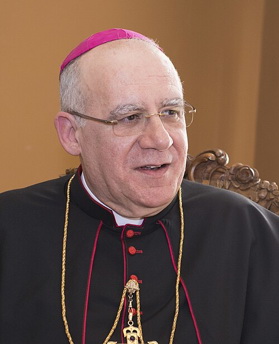
H.E. Archbishop Pedro López Quintana serves as the Apostolic Nuncio of the Holy See to Austria. An Apostolic Nuncio is the Holy See’s diplomatic representative to a country and has a role comparable to that of an ambassador. Archbishop López Quintana is a career diplomat of the Holy See and a member of the Vatican diplomatic service.
Born in 1944 in Barbastro, Spain, he was ordained a priest in 1970 and entered the diplomatic service of the Holy See in 1980. Throughout his diplomatic career, he served in several Apostolic Nunciatures and within the Secretariat of State of the Holy See. He previously served as Apostolic Nuncio to Canada (2013–2019) and Apostolic Nuncio to Lithuania, Estonia and Latvia (2003–2009), as well as holding senior positions in the Holy See’s diplomatic structures. (vatican.va)
Archbishop López Quintana was appointed Apostolic Nuncio to Austria in 2019. His mission focuses on maintaining diplomatic relations between the Holy See and Austria, supporting cooperation on religious, cultural, humanitarian, and international issues. Austria is historically significant for the Catholic Church, and relations include cooperation in education, cultural heritage preservation, social policy, and humanitarian initiatives.
History
Relations between the Holy See and Austria are among the oldest diplomatic relationships in Europe. The Holy See has maintained diplomatic representation in Vienna for centuries, reflecting Austria’s historic role within European Christianity and the Catholic tradition. Modern diplomatic relations continued after the establishment of the Republic of Austria in 1918, with the Holy See maintaining an Apostolic Nunciature in Vienna.
Relations are considered very close and traditionally friendly, based on shared historical, cultural, and religious ties. The relationship is also institutionalised through agreements such as the 1933 Concordat between Austria and the Holy See, which remains an important legal framework governing aspects of Church–state relations. Cooperation today extends beyond religious matters, including education, cultural heritage, humanitarian assistance, social issues, and international peace efforts.
