
Discovering Kazakhstan Through the Great Steppe
Kazakhstan’s Embassy in Berlin Brings the Great Steppe Closer
September 28th, 2026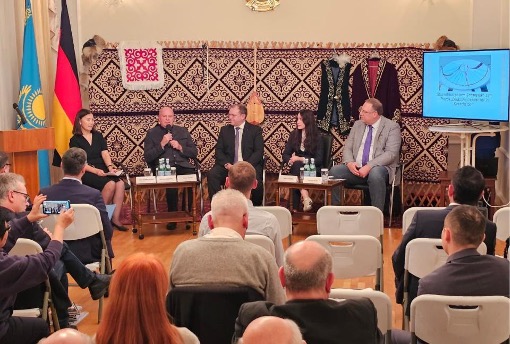
What can the Great Steppe tell us about Kazakhstan today? This was the central question of the gathering on 10 Sempteber in Berlin, where the Embassy of Kazakhstan invited guests to explore the country's history through archaeology, nomadic culture and the changing meaning of the steppe. Held at the Maritim proArte Hotel, the event brought Kazakhstan's past into conversation with German scholarship and contemporary cultural exchange.
Under the theme “The Great Kazakh Steppe – The Glitter of Scythian Gold and the Early History of Nomadic Cultures of Eurasia,” participants travelled through thousands of years of Central Asian history. Kazakhstan's Ambassador to Germany, Nurlan Onzhanov, presented the steppe not simply as a landscape, but as an important part of Kazakhstan's cultural identity. He also drew a connection between the mobility of ancient nomadic societies and today's “digital nomads”, suggesting that the spirit of movement continues in different forms.
The programme brought together prominent German and Kazakh-related academic perspectives. Prof. Dr. Anton Gass of Berlin's Museum of Prehistory and Early History spoke about the Scythian burial mounds of Berel in the Kazakh Altai, where remarkably preserved artefacts, clothing and horse equipment have provided insights into the region's ancient cultures. Prof. Dr. Finn Schreiber of the German Archaeological Institute introduced the lesser-known Zhety-Asar culture, whose fortified settlements developed along the Syr-Darya between approximately 300 BC and 600 AD.
The evening also looked towards the future. Ambassador Onzhanov announced that the smac – State Museum of Archaeology Chemnitz is preparing a major exhibition on the archaeology of Kazakhstan for October 2027 to March 2028. Around 250 objects from the National Museum of the Republic of Kazakhstan, including gold ornaments, weapons and horse equipment, are expected to be displayed in Saxony. The exhibition will give German audiences another opportunity to encounter Kazakhstan's history beyond the country's contemporary political and economic profile.
The gathering illustrates how cultural diplomacy can work through knowledge and dialogue. By inviting German researchers and the public to explore Kazakhstan's heritage, the Embassy created a space in which archaeology became a bridge between the two countries. As Ambassador Onzhanov emphasised, scientific dialogue can connect people, promote mutual understanding and open new perspectives for future cooperation. In this sense, presenting the Great Steppe in Berlin is not only an act of cultural representation; it is also a way of building relationships through shared knowledge and curiosity.
The evening ended with traditional Kazakh food, including bauyrsaq, balkaimak and kaymak, giving guests an opportunity to experience another dimension of the country's culture. The event showed that the Great Steppe is more than a geographical space: it is a collection of stories, traditions and historical connections that Kazakhstan is increasingly bringing into international cultural dialogue.
References:
- https://www.entdecke-kasachstan.de/veranstaltungen/6-stammtisch-unter-dem-schanyrak/
- https://www.gov.kz/memleket/entities/mfa-berlin/press/article/details/231291?lang=en
