
Business as a Cultural Bridge: UK Corporations and the Power of Culture
How British companies are connecting people through music, art, craft and creative exchange
October 06th, 2026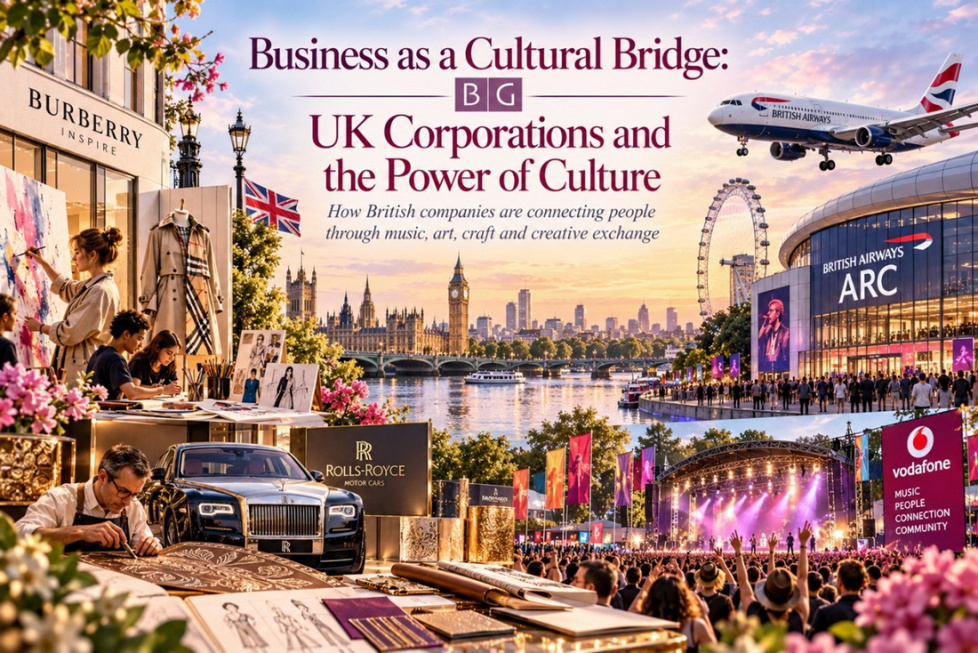
The United Kingdom's corporate landscape extends well beyond finance, technology and traditional industry. It also operates within one of the world's most internationally connected cultural economies. In 2024, the UK's creative industries generated an estimated £145.8 billion in gross value added, equivalent to around 5.5% of the country's GVA. The sector includes music, film and television, visual and performing arts, design, fashion and creative technology.
This environment has increasingly created space for companies to engage with culture not only as a commercial asset, but also as a platform for creativity, education and international exchange. From fashion houses supporting young artists to airlines investing in live entertainment and technology companies connecting audiences to music festivals, corporate activity can contribute to the circulation of British cultural production at home and abroad.
Recent initiatives by Burberry, Rolls-Royce Motor Cars, British Airways and Vodafone illustrate four different approaches. Their projects range from youth programmes and craftsmanship to live music and creative industries, showing how businesses can become participants in the wider cultural ecosystem.
Burberry: Investing in the Next Generation of Creativity
Burberry's Burberry Inspire programme has expanded its international reach through a new partnership with the Burberry Foundation and the International Youth Foundation. Launched in 2018, the programme has already reached more than 10,000 students in the UK and United States. The new phase aims to reach more than 500,000 young people over three years through a network of regional partners.
The programme combines visual and performing arts with STEM-related skills and personal development. Its UK partner, OnSide, works with young people through youth centres, while international partners include organisations in Japan, South Korea, Italy and the United States. This geographical reach gives the programme a clear cross-cultural dimension.
Burberry's approach places creativity at the centre of youth development. Rather than focusing exclusively on fashion, the initiative uses artistic expression as a way for young people to develop confidence, communicate their ideas and participate in their communities.
The project therefore illustrates how a British fashion company can use its international network to support cultural participation across different countries. For cultural diplomacy, the relevance lies in the exchange of creative practices and in giving younger generations opportunities to engage with culture beyond national boundaries.
Rolls-Royce: Bringing Centuries of Craft into Contemporary Design
In May 2026, Rolls-Royce Motor Cars presented four new Bespoke craft techniques at London Craft Week, drawing on traditions from the decorative arts. The techniques — 3D leather hand-sculpting, 3D metal hand-sculpting, 3D veneers and beadwork application — were developed by the company's designers and craftspeople at Goodwood.
The project connects contemporary luxury manufacturing with historical craftsmanship. Rolls-Royce describes its Bespoke Collective as a team dedicated not only to creating personalised vehicles, but also to developing new approaches to craft, texture and materials. The company has also participated in London Craft Week, an international festival involving more than 1,000 makers from over 30 countries.
The initiative demonstrates how traditional knowledge can be incorporated into contemporary industrial design. Craft techniques associated with decorative arts, jewellery, architecture and haute couture are reinterpreted within an automotive context.
For a company whose products are sold internationally, this creates a distinctive form of cultural exchange: British craftsmanship becomes part of a global conversation about design, materials and artistic practice. The activity also places skilled makers at the centre of the corporate story, highlighting the relationship between industrial innovation and cultural heritage.
British Airways: Turning an Airline into a Cultural Platform
In June 2026, British Airways opened British Airways ARC at Olympia, a new 3,800-capacity live entertainment and music venue in London. The venue forms part of the £1.3 billion transformation of Olympia and opened with performances by artists including Self Esteem and McFly, with Van Morrison, Khalid and The Black Keys among the acts scheduled later in the year.
The airline also used the opening to launch its Cloudscapes campaign, highlighting talent from The BRIT School, one of the UK's best-known institutions for creative education.
The initiative represents an unusual connection between aviation and cultural life. British Airways' traditional role is to connect Britain with international destinations; through ARC, the company is also positioning itself within the cultural infrastructure of the city from which many of its international routes originate.
Music becomes a second form of connectivity. The project brings together audiences, performers and emerging creative talent while linking a major British company with London's entertainment ecosystem.
From a cultural diplomacy perspective, such initiatives show how businesses associated with international mobility can also participate in the creation and circulation of culture at home. The airport and the concert venue become two different forms of connection: one physical, the other cultural.
Vodafone: Connecting Audiences at Britain's Music Festivals
In March 2026, Vodafone announced a new multi-year partnership with six major UK festivals organised by Live Nation. From 2026, Vodafone became Official Connectivity Partner for Reading & Leeds, Latitude, Download, Camp Bestival, Wilderness and another Live Nation festival, while customers of Vodafone and Three received access to festival rewards.
The partnership goes beyond conventional sponsorship. Vodafone connects its telecommunications infrastructure directly with the experience of live music, emphasising the role of connectivity in allowing audiences to share performances and experiences in real time.
The company has also linked the initiative to its wider investment in the UK's digital infrastructure, including an announced £11 billion investment in its network.
The cultural significance lies in the relationship between technology and participation. Festivals are spaces where music, identity and community come together, while digital networks increasingly determine how audiences experience and communicate those moments.
By placing connectivity at the centre of major cultural gatherings, Vodafone demonstrates another way in which corporate activity can intersect with cultural life: not by producing the cultural content itself, but by providing the infrastructure through which audiences experience and share it.
References:
- https://de.burberry.com/c/storys/community/burberry-inspire/
- https://www.press.rolls-roycemotorcars.com/rolls-royce-motor-cars-pressclub/article/detail/T0457690EN?language=en
- https://mediacentre.britishairways.com/news/16062026/british-airways-arc-opens-its-doors-at-olympia-marking-londons-newest-live-entertainment-venue-in-over-a-decade
- https://www.vodafone.co.uk/newscentre/consumer/partnership-six-live-nation-uk-festivals/
