
BMW: Cultural Diplomacy Through Art, Music and International Exchange
Five cultural initiatives connecting artistic innovation, public access and international dialogue.
October 20th, 2026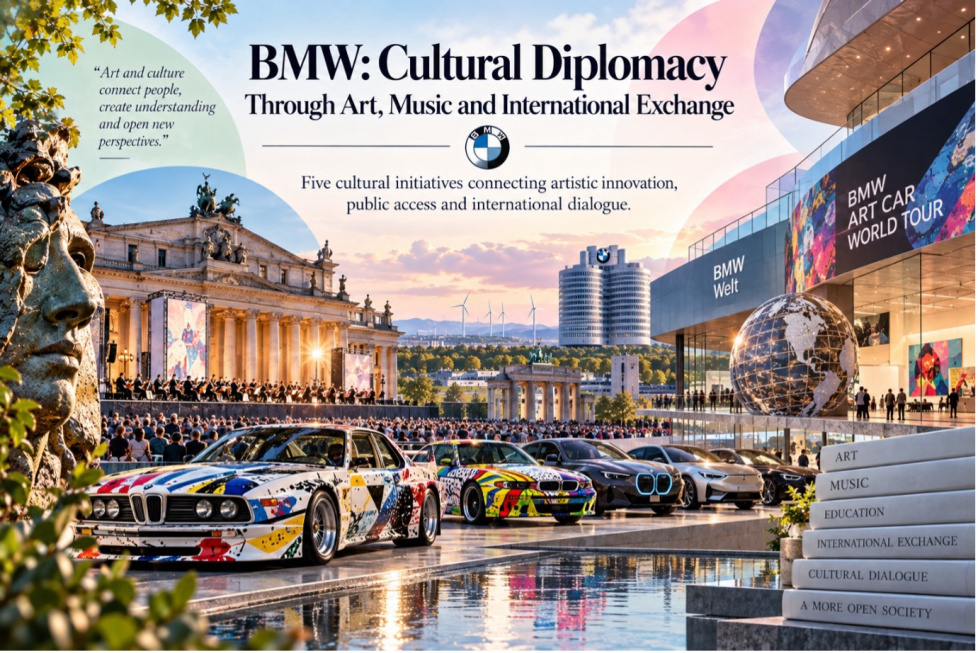
Cultural diplomacy increasingly extends beyond traditional institutions and government-led exchanges. Companies can also contribute by supporting artistic production, facilitating access to cultural experiences and creating opportunities for dialogue across countries and disciplines. BMW provides an example of this approach through its long-term engagement in contemporary art, photography, opera and orchestral music.
Rather than treating culture solely as a form of corporate sponsorship, BMW’s initiatives connect artists, museums, cultural institutions and audiences around shared creative experiences. The five examples below illustrate how these activities can support international exchange, broaden public participation and encourage reflection on contemporary social and environmental challenges.
BMW Art Car World Tour: Bringing Art and Technology Together
Launched in 1975, the BMW Art Car Collection brings together automotive design and contemporary art, inviting internationally recognised artists to transform vehicles into artistic works. In 2025–2026, the collection’s 50th anniversary was marked by the BMW Art Car World Tour, an international exhibition programme spanning more than 30 countries across five continents. Its culmination was an exhibition at BMW Welt in Munich from 29 July to 31 August 2026, where all 20 Art Cars were presented together for the first time. The exhibition attracted more than 120,000 visitors.
The collection includes works by artists such as Alexander Calder, David Hockney and Julie Mehretu, reflecting different artistic movements and cultural contexts. By placing art on a medium more commonly associated with engineering, mobility and industrial production, the project challenges conventional boundaries between artistic expression and technology. Its international touring format also enables audiences in different countries to encounter a shared collection while interpreting it through their own cultural perspectives.
From a cultural diplomacy perspective, the Art Car World Tour demonstrates how an internationally recognisable corporate platform can facilitate encounters between artistic traditions, technological innovation and public audiences. The project’s contribution lies not simply in promoting a brand, but in making contemporary art accessible in diverse locations and creating a common cultural reference point across national borders.
Staatsoper für alle 2026: Making Classical Music Accessible in Berlin
On 23 and 24 May 2026, BMW and the Staatsoper Unter den Linden presented the twentieth edition of Staatsoper für alle, a free open-air cultural event held at Bebelplatz in central Berlin. The programme included a live screening of Giuseppe Verdi’s Nabucco, followed by performances involving the Opernkinderorchester and youth choir, and an open-air concert by the Staatskapelle Berlin conducted by Christian Thielemann. The event invited Berlin residents and international visitors to experience opera and classical music without purchasing a ticket.
The initiative addresses a central challenge for cultural institutions: how to make art forms traditionally associated with formal venues and potentially high costs accessible to a broader public. By moving performances into a prominent public square, the event reduces practical and social barriers to participation. Its inclusion of young musicians also highlights the importance of cultural education and the development of future audiences.
Although the initiative is rooted in Berlin, its cultural diplomacy relevance extends beyond the local context. The city attracts international visitors and is home to diverse communities, making public cultural events opportunities for people with different backgrounds to share an experience. The long-standing collaboration between BMW and the Staatsoper also illustrates how private-sector support can help established cultural institutions engage with society outside their usual venues.
Preis der Nationalgalerie 2026: Contemporary Art and Critical Dialogue
BMW has supported Berlin’s Preis der Nationalgalerie since 2006, contributing to a long-term partnership focused on contemporary art. In 2026, the prize was associated with MAURIZIO CATTELAN. NIGHT, the Italian artist’s first major solo exhibition in Germany. Presented at Berlin’s Neue Nationalgalerie from 10 September 2026 to 7 March 2027, the exhibition brings together significant earlier works and a new site-specific installation. Its themes include history, power, memory, identity and belief.
The exhibition offers an example of how support for contemporary art can create space for critical reflection. Cattelan’s work often uses irony and ambiguity to question established symbols and authority. In NIGHT, the relationship between the artworks and the architecture of the Neue Nationalgalerie further encourages visitors to reconsider familiar historical and cultural references. The involvement of an Italian artist in a major Berlin institution also places the exhibition within a wider European and international art scene.
The partnership’s significance lies in its continuity. By supporting an established cultural prize over two decades, BMW contributes to the infrastructure through which contemporary artistic practices can reach wider audiences. The exhibition does not prescribe a single interpretation of its subject matter; instead, it creates a setting in which visitors can engage with different perspectives on history and society.
From a cultural diplomacy perspective, this initiative illustrates the role of museums and international artistic exchange in fostering dialogue across cultural boundaries. It also highlights Berlin’s position as a meeting point for artists, curators and audiences from different countries.
BMW ART MAKERS 2026: Photography, Science and Environmental Questions
BMW ART MAKERS is a patronage programme that supports collaboration between artists and curators in the development of new visual art projects. In 2026, artist and medical biologist Lara Tabet and curator Yasmine Chemali were selected for Le corps vitré. The project combines photography, biological research and ecological reflection, using an experimental process in which microorganisms from aquatic environments interact with photosensitive surfaces to produce images. These works are presented as contemporary stained-glass forms, making normally invisible biological processes visible through artistic practice.
The project was presented at the Rencontres d’Arles photography festival in France from 6 July to 4 October 2026, with a further presentation scheduled for Paris Photo at the Grand Palais in Paris from 12 to 15 November 2026. These events provide platforms for the work to reach different audiences and engage with international conversations about contemporary photography. BMW’s long-standing partnerships with both festivals also connect the programme to established networks of artists, curators and cultural professionals.
Beyond financial support, the programme gives artists and curators resources to research, experiment and present new work. Le corps vitré is particularly relevant because it connects artistic creation with scientific inquiry and environmental concerns. By drawing attention to aquatic ecosystems and the effects of human activity on the environment, the project creates opportunities to discuss issues that cross national boundaries.
Its cultural diplomacy value lies in facilitating collaboration across disciplines and in bringing an internationally relevant subject into cultural spaces. The participation of an artist with a background in medical biology and a curator whose work engages with photography and cultural collections further demonstrates how different professional and cultural experiences can inform artistic production.
BMW Classics 2026: Orchestral Music and Public Participation in Munich
On 16 September 2026, BMW and the Bavarian State Opera presented the BMW Classics concert at BMW Park in Munich as part of the institution’s Opera for All programme. Admission was free, with tickets required, and the event was also made available through a livestream. The 2026 edition featured the Bavarian State Orchestra and included the Bavarian State Ballet for the first time.
The event extends the principle of cultural accessibility beyond traditional opera-house settings. By bringing orchestral music to a different venue and offering a livestream, it creates additional ways for audiences to engage with classical performance. The collaboration between the orchestra and ballet also connects different performing arts, showing how cultural institutions can develop new formats while maintaining their artistic traditions.
As a partnership between a major cultural institution and a private company, BMW Classics illustrates how corporate support can help sustain public-facing cultural programmes. Its contribution to cultural diplomacy is more indirect than that of an international touring exhibition, but it remains relevant: orchestral music and ballet are art forms with transnational histories, repertoires and audiences. Making them more accessible can strengthen public engagement with cultural heritage and create opportunities for shared cultural experiences.
Culture as a Bridge for International Dialogue
BMW’s cultural engagement in 2026 demonstrates several ways in which corporate initiatives can contribute to cultural diplomacy. The BMW Art Car World Tour uses an international exhibition network to connect art and technology; Staatsoper für alle and BMW Classics expand access to classical music; the Preis der Nationalgalerie supports contemporary artistic dialogue; and BMW ART MAKERS encourages collaboration between visual art, science and environmental research.
These initiatives differ in their audiences and geographic reach, but they share a commitment to enabling artistic creation and bringing cultural experiences to the public. Their diplomatic value should not be measured solely by attendance or international visibility. It also lies in the relationships they support between cultural institutions, artists and communities, and in their capacity to open spaces for exchange and reflection.
BMW’s example illustrates both the opportunities and the limits of corporate cultural diplomacy. Private-sector partnerships can provide resources, visibility and access, while the credibility of such initiatives depends on the autonomy of artists, the quality of institutional collaboration and the meaningful participation of audiences. When these conditions are maintained, cultural engagement can become more than corporate sponsorship: it can serve as a platform for dialogue across artistic, social and national boundaries.
References:
- https://www.bmwgroup.com/en/news/general/2025/bmw-art-cars.html
- https://www.staatsoper.de/en/productions/opera-for-all-konzert-zum-unicredit-septemberfest/2026-09-16-1900-16460
