
Asian Embassy Activities Build Connections Through Cultural Diplomacy
Four cities, four forms of cultural diplomacy
September 29th, 2026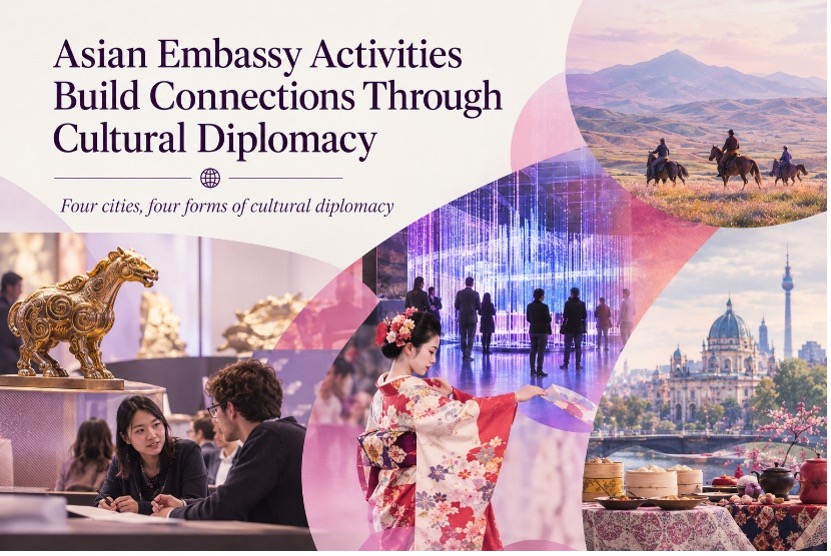
Across Europe, Asian embassies and diplomatic missions are using culture to create connections that reach beyond formal political relations. In recent months, events in Berlin, Vienna, London and Geneva have brought together diplomats, artists, researchers, students and members of the public around different forms of cultural exchange. From the archaeology of Kazakhstan’s Great Steppe to Japan’s participation in a festival devoted to art and technology, and from UK–China educational cooperation to an Asian cultural festival in Geneva, each initiative uses a different language of engagement.
Yet they share a common purpose: creating opportunities for people to encounter another country through its history, creativity, knowledge and everyday traditions. These activities also show how cultural diplomacy is becoming increasingly diverse. It is no longer limited to exhibitions or official cultural programmes; it can take place in universities, scientific and artistic festivals, academic discussions, food stalls and even on a stage. Together, these four events offer a glimpse of how diplomatic missions are using culture to build familiarity, encourage dialogue and strengthen relationships between countries and their societies in an increasingly interconnected world.
Discovering Kazakhstan Through the Great Steppe in Berlin
In Berlin, Kazakhstan’s Embassy turned archaeology into a meeting point between history and contemporary cultural exchange. The latest edition of “Stammtisch unter dem Schanyrak”, held at the Maritim proArte Hotel, invited guests to explore the Great Kazakh Steppe through the archaeology of Scythian cultures and the early history of Eurasian nomadic societies. The event presented the steppe not simply as a landscape, but as a central element of Kazakhstan’s cultural identity.
Ambassador Nurlan Onzhanov connected the mobility of ancient nomadic peoples with the idea of today’s “digital nomads”, while academic contributions brought this history to life. Prof. Dr. Anton Gass of Berlin’s Museum of Prehistory and Early History spoke about the Scythian burial mounds of Berel in the Kazakh Altai, while Prof. Dr. Finn Schreiber of the German Archaeological Institute presented the lesser-known Zhety-Asar culture and its settlements along the Syr-Darya.
The gathering also looked towards future exchange. A major exhibition on Kazakhstan’s archaeology is planned at the State Museum of Archaeology Chemnitz from October 2027 to March 2028, with around 250 objects expected from Kazakhstan’s National Museum. The Berlin event therefore shows how cultural diplomacy can work through scholarship: sharing history and knowledge can create curiosity, mutual understanding and new opportunities for cooperation.
Japan Connects Art and Technology Through Cultural Diplomacy in Vienna
In Vienna, Japan used one of Europe’s most international platforms for digital art to present a contemporary face of its culture. On 10 September, the Japanese Embassy in Austria hosted “JAPAN CONNECT” in Linz during the 2026 Ars Electronica Festival, bringing together Japanese artists, companies and representatives of cultural and educational institutions with Ars Electronica representatives.
In his remarks, Ambassador Iwama emphasised Ars Electronica’s ability to connect art, science, technology and society, describing creativity as a way to encourage free and open dialogue. He also highlighted the long-standing participation of Japanese artists, who have presented both Japanese traditions and contemporary creativity to an international audience.
The international scale of the festival reinforced this message. From 9 to 13 September, Ars Electronica welcomed 125,000 visitors across 40 exhibition venues and brought together more than 1,200 artists, scientists and activists from 77 countries. Japan’s participation therefore extends cultural diplomacy beyond traditional arts, using innovation, creativity and technology as platforms for exchange. Ambassador Iwama linked this cooperation to strengthening Japan-Austria relations ahead of the 160th anniversary of friendship between the two countries in 2029.
More Than Education: How Uk–China Exchange Is Building Trust
In London, education became the starting point for a wider conversation between Britain and China. On 17 September 2026, around 120 guests from the two countries gathered for a cultural and educational exchange event hosted by China Daily and supported by the Chinese Embassy. Representatives from the arts, media, business and academia joined students and scholars to discuss how education and cultural exchange can create greater understanding.
UCL President and Provost Michael Spence highlighted the role of universities in building long-term relationships across borders, pointing to cooperation between UCL and Chinese institutions, including research partnerships with Peking University. Language was another focus: UCL’s Mandarin Excellence Programme has enabled almost 10,000 pupils across England to study Mandarin since 2016.
Young people were also placed at the centre of the programme. A UK–China Youth Dialogue examined the importance of education and cultural exchange in shaping future relations, while a joint classical performance created another opportunity to share cultures. The event concluded with a networking reception, reinforcing the idea that cultural diplomacy can operate through universities and people-to-people relationships.
One Festival, nearly 30 Countries: Asia Meets In Geneva
In Geneva, culture became a meeting place for diplomats from across Asia. On 2 September, the Permanent Mission of China to the United Nations Office at Geneva and other international organisations took part in the sixth Asian Culture Festival, jointly organised by the Asian Ambassadors’ Wives Association in Geneva and the World Intellectual Property Organization. Representatives of nearly 30 Asian countries and international organisations attended, with proceeds going to charity.
The Chinese Mission took an active role in the programme. Chinese diplomats performed on stage, presented traditional food and introduced handicrafts and cultural practices to visitors. The programme included dishes such as baozi and Sichuan-style spicy chicken, as well as crafts including Zhuang brocade and tie-dyed handbags. A screening of Beautiful China also presented the diversity of Chinese cultures and landscapes.
The festival demonstrates a particularly direct form of cultural diplomacy. Diplomats themselves became cultural representatives, using performance, food and craftsmanship to create informal encounters with colleagues and visitors from other countries. In an international city such as Geneva, where diplomatic relations are usually conducted through formal institutions, these personal and cultural exchanges offer another way of building familiarity and dialogue. China’s participation for the sixth consecutive year further underlines the festival’s role as a continuing platform for cultural exchange.
Conclusion
Taken together, the four initiatives show how diverse cultural diplomacy can be. In Berlin, archaeology and historical research open a window onto Kazakhstan’s identity; in Vienna, technology and contemporary art provide a platform for Japanese creativity; in London, universities and young people create long-term links between Britain and China; and in Geneva, food, performance and craftsmanship bring diplomats together through shared experiences.
What connects these activities is the idea that international relations are also built outside official negotiations. Cultural diplomacy works by creating opportunities to encounter another country through its stories, knowledge, creativity and traditions. For embassies and diplomatic missions, these encounters can strengthen mutual understanding while giving culture a role in shaping how countries see one another. Across Europe, these four examples show that diplomacy can begin with a conversation about archaeology, a technological artwork, a classroom or even a shared meal.
References:
- https://www.at.emb-japan.go.jp/itpr_de/12_taishi20260910.html
- https://www.entdecke-kasachstan.de/veranstaltungen/6-stammtisch-unter-dem-schanyrak/
- https://www.ucl.ac.uk/news/2026/sep/ucl-provost-speaks-uk-china-cultural-exchange-event
- https://geneva.china-mission.gov.cn/eng/tpxw/202609/t20260904_12016033.htm
