
Asia in the City: How Embassies Use Culture to Build Bridges
Five diplomatic initiatives connect Asian traditions with international audiences
October 09th, 2026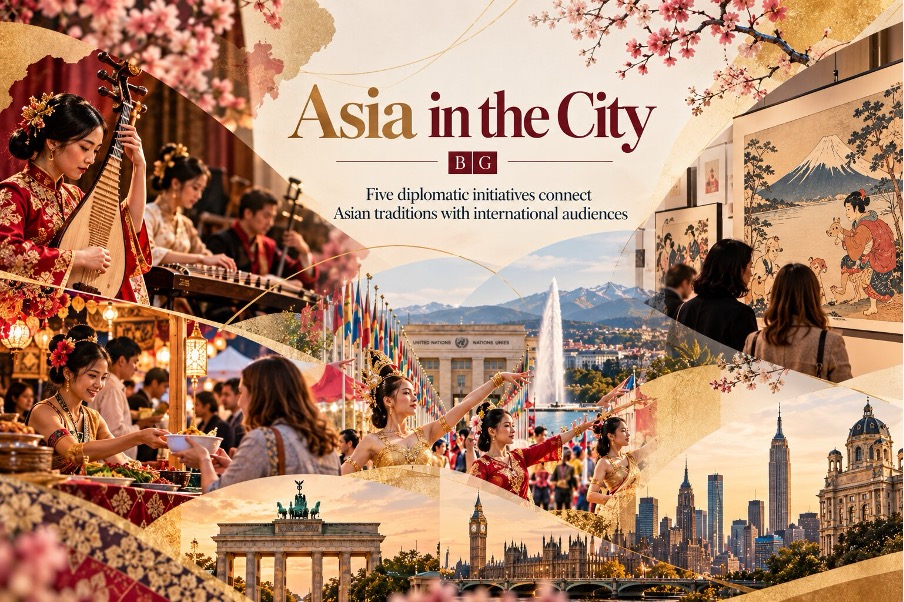
From traditional Chinese music in Berlin to contemporary Thai art in New York, Asian diplomatic missions are using culture to strengthen international connections. Across Berlin, London, Geneva, New York and Vienna, exhibitions, festivals, artistic performances and storytelling initiatives have brought Asian cultural traditions into dialogue with local communities. Although each activity has its own character, they share a common purpose: creating opportunities for people to encounter different cultures, exchange perspectives and build relationships beyond national borders.
Berlin: Chinese and German Artists Share the Stage
On 6 September 2026, the Embassy of the People’s Republic of China in Germany organised a cultural performance entitled Mid-Autumn Night at the Deutsches Theater in Berlin. More than 200 guests attended the event, which brought together over 30 artists from China and Germany in a celebration of cultural exchange.
The programme featured performers from the Huaxia Ancient Music Orchestra of the Henan Museum and the Chengdu Sichuan Opera Research Institute, alongside Berlin’s Canzonetta choir. The combination of Chinese traditional music, Sichuan opera and German choral performance placed different artistic traditions on the same stage.
Rather than presenting Chinese culture in isolation, the performance created a shared space in which artists from both countries could contribute to a common programme. This distinction is important for cultural diplomacy: the encounter becomes more meaningful when audiences can experience different traditions together, rather than simply learning about them separately.
The embassy also used the occasion to emphasise the importance of cultural and people-to-people exchanges in Chinese-German relations. Performances such as this can make international relationships tangible by connecting diplomatic objectives with artistic experiences that audiences can enjoy and discuss.
Music and performance offer a particularly accessible form of communication. While historical traditions and artistic techniques may differ, they can still create shared experiences that transcend language barriers. In Berlin, the meeting between Chinese performers and a German choir showed how artistic collaboration can encourage curiosity about another society.
The event illustrates how an embassy can use cultural programming to complement formal diplomacy, connecting bilateral relations with the everyday experiences of artists and audiences.
London: Celebrating Southeast Asia Together
In London, the Royal Thai Embassy joined the diplomatic missions of fellow ASEAN member states and Battersea Power Station to present CelebrASIA 2026, a festival celebrating Southeast Asian culture from 11 to 13 September.
The programme brought together food, music, cultural performances, handicrafts and family-friendly activities, offering visitors an introduction to the region’s diverse cultural traditions. Thailand’s contribution included street food, traditional products, classical dance and a performance by the Thai Music Circle.
The festival also explored the relationship between food and cultural identity. Thai chef John Chantarasak of AngloThai participated in a discussion entitled Feast & Flavour: The Art of Sharing Identity Through Food, highlighting how cuisine can communicate heritage and personal experience across cultures.
What makes CelebrASIA particularly interesting from a cultural-diplomacy perspective is its regional approach. Rather than focusing on one country's national image, the initiative created a platform for several Southeast Asian countries to present their cultures alongside one another.
This collaborative model reflects the role of ASEAN cooperation beyond political and economic affairs. Cultural initiatives can introduce audiences to the diversity of the region while demonstrating how countries can work together through shared public activities.
London’s international population provided a natural setting for the festival. Visitors could discover unfamiliar food, watch performances and engage with cultural traditions in an informal environment. Such encounters may seem simple, but they can challenge stereotypes and encourage interest in societies that audiences might otherwise know mainly through news coverage or political debate.
By participating in CelebrASIA, the Royal Thai Embassy helped connect Thailand’s cultural heritage with a broader regional platform, demonstrating how cultural diplomacy can build understanding both between countries and between communities.
Geneva: Asian Cultural Cooperation on a Multilateral Stage
On 2 September 2026, the Asian Ambassadors’ Wives Association Geneva organised Asian Festival 2026 at the headquarters of the World Intellectual Property Organization (WIPO). Under the theme Wonders of Asia, the event brought together the association’s members and diplomatic missions representing 25 countries.
Visitors encountered traditional arts and crafts, food and cultural performances from across Asia. Japan was represented by the Permanent Mission of Japan to the International Organizations in Geneva, which presented Japanese culture through a matcha demonstration, Japanese food and desserts, and a performance of Nihon-Buyo, a traditional Japanese dance.
The event also had a charitable dimension. Proceeds were set to be donated through the association to Cancer Support Switzerland and the Au Coeur des Grottes Foundation, which supports victims of trafficking.
Geneva provides a particularly relevant setting for this kind of initiative. Known internationally for its diplomatic missions and multilateral institutions, the city offers opportunities for countries to cooperate outside formal negotiations. Asian Festival 2026 used that international environment to bring cultural expression into a shared public setting.
Its strength lay in the participation of multiple countries. Each presented elements of its own heritage, but all contributed to a larger event that highlighted the breadth and variety of Asian cultures. Japan’s contribution was therefore part of a wider collective effort rather than a standalone national presentation.
The inclusion of charitable support added another layer to the initiative, connecting cultural exchange with local needs and community engagement. It also showed how diplomatic communities can collaborate around shared social purposes.
Asian Festival 2026 demonstrates how cultural diplomacy can operate within a multilateral environment: countries maintain their individual identities while creating opportunities for cooperation, public engagement and mutual understanding.
New York: Thai Artists Reinterpret Their Cultural Identity
On 17 May 2026, the Royal Thai Consulate-General in New York organised THAI NEXT 2026: When the Seeds Bloom, in partnership with the Thai Theatre Foundation. Held at The Foundry in Long Island City, the event showcased the work of more than 40 Thai and Thai-American artists and attracted approximately 900 visitors throughout the day.
The multidisciplinary arts fair featured visual art, music and performance, alongside interactive workshops and activities highlighting Thai crafts and creativity. Visitors could explore Thai silk embroidery, take part in orchid-inspired craft activities and discover food and creative products offered by Thai entrepreneurs.
However, the event was about more than introducing traditional Thai culture to an American audience. By bringing together Thai and Thai-American artists, THAI NEXT created a platform for contemporary interpretations of Thai identity shaped by different experiences, backgrounds and creative influences.
This is an especially relevant dimension of cultural diplomacy. Culture does not remain unchanged when people move between countries or grow up within more than one cultural environment. Artists often reinterpret their heritage through new artistic languages, combining familiar traditions with the influences of the societies in which they live and work.
For the Royal Thai Consulate-General, supporting this creative community offered a way to present Thailand through contemporary artistic practice, rather than relying exclusively on established cultural symbols. It also gave participating artists greater visibility within the American arts and creative sectors.
The initiative formed part of Thailand’s efforts to promote its cultural influence, often described as soft power, in the United States. Yet its significance extends beyond national promotion. By creating a meeting point for artists, cultural professionals and the wider public, THAI NEXT encouraged audiences to engage with Thai identity as something living, diverse and continually evolving.
New York’s multicultural environment made this exchange particularly meaningful. The event showed how diaspora communities and contemporary artists can help connect societies, acting as cultural bridges between their heritage and the places in which they live and create.
Vienna: How Japanese Fairy Tales Travelled to Europe
On 1 June 2026, the Embassy of Japan in Austria opened an exhibition entitled Mukashi, mukashi… How Japanese Fairy Tales Came to Europe at its Information and Cultural Centre in Vienna.
The exhibition explored how Japanese fairy tales reached Europe between the late nineteenth and early twentieth centuries, and how their circulation contributed to European understanding of Japanese culture. It presented books preserved by researchers and the University of Vienna Library, alongside woodblock prints and other objects inspired by Japanese stories.
The exhibition also drew on academic expertise. Its curatorial team included researchers from the University of Vienna and the University of Innsbruck, connecting diplomatic cultural programming with university research and historical interpretation.
At the opening, visitors were introduced to well-known Japanese tales, including Momotaro, Princess Kaguya and Urashima Taro. The programme concluded with a traditional kamishibai, or paper-theatre, performance of Bunbuku Chagama, bringing one of the stories to life through a combination of images and oral narration.
The exhibition offered a different perspective from the festivals and performances in the other cities. Rather than focusing primarily on a contemporary exchange, it explored how cultural ideas travel across time and geographical boundaries.
Stories are an important part of cultural identity. They communicate values, moral lessons, humour and ways of understanding the world. When they are translated, published or retold in another country, they can introduce audiences to unfamiliar traditions while also being interpreted through local perspectives.
By examining the historical journey of Japanese fairy tales into Europe, the Embassy of Japan provided an opportunity to reflect on cultural exchange as a long-term process. It also demonstrated how collaboration with academic institutions can deepen the experience beyond a conventional exhibition.
The Vienna initiative highlighted a central principle of cultural diplomacy: understanding another society does not begin only through official visits or contemporary events. It can also develop through the stories people read, the images they encounter and the narratives they pass from one generation to another.
From Berlin’s shared musical stage to Vienna’s travelling fairy tales, these five activities demonstrate the different ways Asian diplomatic missions can use culture to foster international understanding. The Embassy of China in Germany brought Chinese and German performers together; the Royal Thai Embassy in London supported a regional celebration of Southeast Asian cultures; Japan’s Permanent Mission in Geneva participated in a multilateral Asian festival; the Royal Thai Consulate-General in New York created a platform for contemporary Thai and Thai-American artists; and the Embassy of Japan in Austria explored the historical journey of Japanese stories into Europe.
Their approaches differ, but the underlying idea is similar: culture creates opportunities for engagement that formal diplomacy alone cannot always provide. Through music, food, art, performance and storytelling, diplomatic missions can make international relationships more accessible, encourage curiosity and connect communities across borders. In this sense, cultural diplomacy is not simply about presenting a country to the world. It is also about creating spaces in which people can encounter one another, exchange perspectives and discover what they share.
References:
- https://www.at.emb-japan.go.jp/itpr_de/20260601.html
- https://newyork.thaiembassy.org/en/content/thai-next-2026-new-perspectives-on-thailand-throu?cate=6250920252d5832ec064d233
- https://www.geneve-mission.emb-japan.go.jp/itprtop_en/event_20260902.html
- https://london.thaiembassy.org/en/content/come-and-experience-the-colours-sounds-and-flavou?cate=5d6636c215e39c3bd0006cb5&menu=5d6636ce15e39c3bd0007332
- https://de.china-embassy.gov.cn/chn/sgyw/202609/t20260908_12018631.htm
